Solar Eclipse Viewing Checklist: Essential Tips, Gear, and Safety
A solar eclipse is one of the most breathtaking astronomical events you can witness with your own eyes—but only if you prepare properly. From finding the right location to choosing safe viewing gear, planning ahead is essential for enjoying the experience without risking eye damage or missing the big moment altogether.
This checklist-style guide walks you through everything you need to know: timing, gear, safety, photography, and practical tips so your eclipse viewing is memorable for all the right reasons.
1. Understand the Basics of a Solar Eclipse
Before you pack your gear, it helps to know what you’re actually seeing in the sky.
A solar eclipse occurs when the Moon passes between the Earth and the Sun, partially or fully blocking the Sun’s light.
Main types of solar eclipses
-
Total solar eclipse
The Moon completely covers the Sun for a brief period. Day turns to twilight, stars and planets may become visible, and the Sun’s corona (outer atmosphere) appears as a glowing halo. -
Partial solar eclipse
Only part of the Sun is obscured by the Moon. The Sun looks like a “bite” has been taken out of it. No corona is visible, and it does not get fully dark. -
Annular solar eclipse
The Moon is slightly farther from Earth and appears smaller, so it doesn’t fully cover the Sun. Instead, you see a “ring of fire” effect. Direct viewing is never safe, even at maximum coverage. -
Hybrid eclipse
A rare type that appears annular in some locations and total in others, depending on your position along the path.
Why your location matters
For a total or annular solar eclipse, you must be within the path of totality or annularity respectively—usually a narrow track that sweeps across Earth’s surface. Just being “in the right country” isn’t enough; a few dozen miles can mean the difference between partial and total coverage.
Use reputable prediction maps and tools—such as NASA eclipse maps (source: NASA Eclipse Web Site)—to check:
- If the eclipse is visible where you live
- Whether it will be total, annular, or partial
- What time each phase starts and ends for your location
2. Plan Your Viewing Location and Timing
Great eclipse viewing is mostly about where and when.
Choose a good viewing spot
Look for a location with:
- Clear views of the sky toward the Sun’s position (often mid to high in the sky, depending on your latitude and time).
- Minimal light pollution (not critical for a solar eclipse, but it enhances the atmosphere and post-eclipse stargazing).
- Low horizon obstructions like tall buildings, trees, or mountains.
- Safe, legal access—parks, open fields, and designated viewing areas are ideal.
- Facilities like restrooms and parking if you’ll be there for several hours.
If you’re traveling to the path of totality or annularity, book:
- Accommodation well in advance (eclipse paths draw big crowds).
- Backup locations within a reasonable driving distance in case of cloud cover.
Check local weather
Clouds can completely obscure a solar eclipse, so weather is crucial.
- Monitor forecast models starting 7–10 days out.
- On eclipse day, have at least one alternate spot that’s likely to have better skies.
- If conditions look marginal, consider driving early toward clearer regions.
Know the exact timeline
Every solar eclipse has four key contact times (for total and annular events):
- First contact – Moon starts crossing the Sun (begins partial phase)
- Second contact – Start of totality or annularity
- Maximum eclipse – Midpoint of coverage
- Third & fourth contacts – End of totality/annularity and then end of the partial phase
Print or save these times for your precise GPS location. Allow at least 1–2 hours before first contact to settle in and test your gear.
3. Solar Eclipse Eye Safety: Non-Negotiable Rules
Eye safety is the most important part of any solar eclipse viewing checklist.
Never look at the Sun without proper protection
Even when the Sun is mostly covered, the remaining light is intense enough to permanently damage your eyes. Regular sunglasses, smoked glass, exposed film, or stacked sunglasses are not safe.
Use only:
- ISO 12312-2 certified solar eclipse glasses
- Handheld solar viewers
- Certified solar filters for telescopes, binoculars, and cameras (designed specifically for solar viewing)
How to verify safe eclipse glasses
- Look for “ISO 12312-2” printed on the glasses.
- Buy from reputable manufacturers or vendors recommended by astronomy groups or major planetariums.
- Check that:
- Lenses are free of scratches, holes, or creases.
- The material is firmly attached to the frame.
- There is no obvious light leakage around the edges.
If in doubt, don’t use them.
The exception: totality
During a total solar eclipse, there is a short window when the Sun is completely blocked and you can safely look without filters:
-
Only remove eclipse glasses when:
- You are inside the path of totality, and
- The Sun is completely covered (no bright crescent at all).
-
Put your eclipse glasses back on:
- As soon as the first bright sliver of the Sun reappears.
For partial or annular solar eclipses, you must keep eye protection on the entire time, from first contact to last.
If you’re unsure whether totality has begun or ended, err on the side of safety and keep your glasses on.
4. Essential Gear Checklist for Solar Eclipse Viewing
Use this list to make sure you don’t forget anything important on eclipse day.
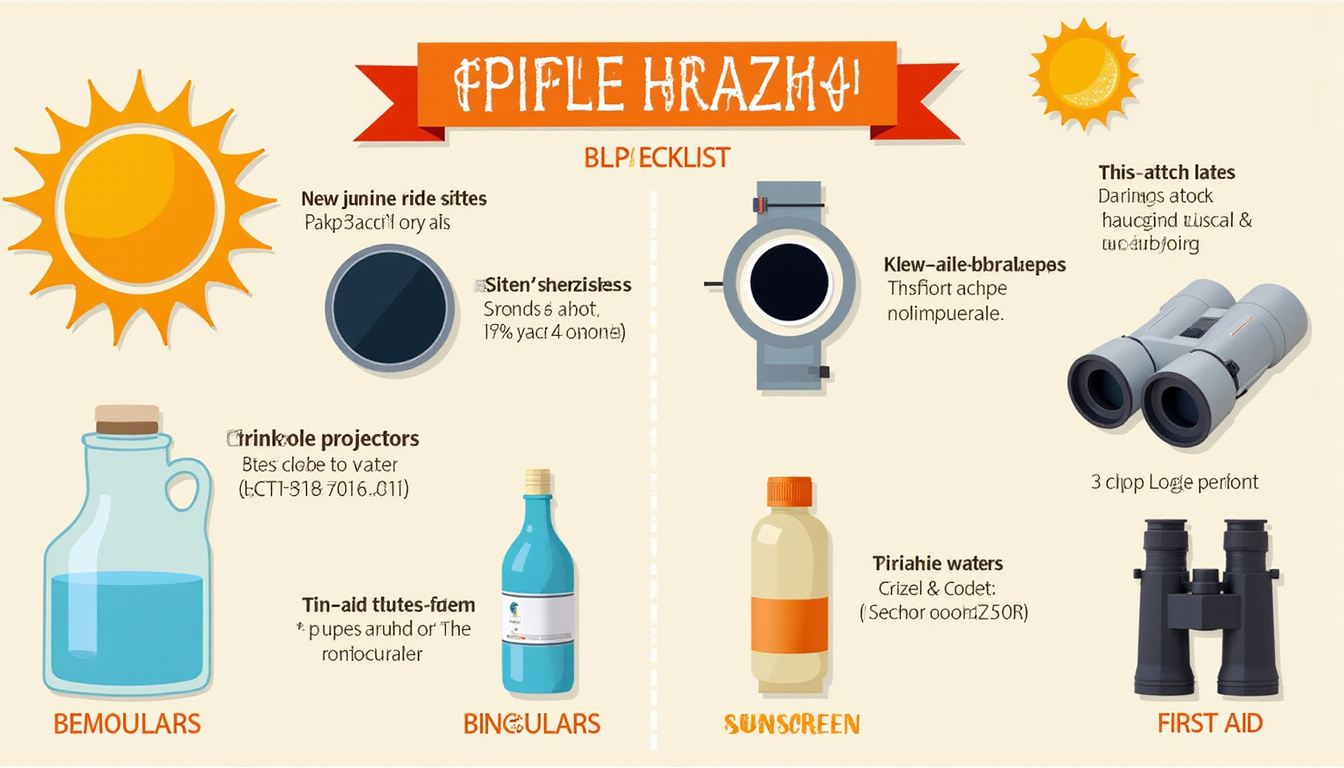
Must-have viewing and safety items
- ISO 12312-2 certified solar eclipse glasses (one pair per person, plus spares)
- Handheld solar viewer as a backup or for sharing
- Solar filters for any optical gear (telescope, binoculars, camera)
- Printed or saved local eclipse times and path map
- Hat and sunscreen (you’ll often be in direct sun for hours)
Comfort and logistics
- Camping chairs or blankets for sitting/lying down
- Drinks and snacks (dehydration is common when you’re out in the sun)
- Layered clothing, jacket, or blanket (temperature can drop during totality)
- Portable shade (umbrella, canopy, or sunshade)
- Power bank for phones and cameras
- Red-light flashlight if you’ll stay for evening observing
For families and groups
- Extra eclipse glasses for children and visitors
- Whistle or identifier in crowded areas so your group can regroup
- Simple pin-hole projection viewer projects (fun and safe for kids)
- A simple safety briefing so everyone understands when glasses must be on
5. Safe Ways to Observe a Solar Eclipse Without Looking Directly
If you don’t have eclipse glasses or want an educational activity, indirect methods let you safely enjoy the event.
Pinhole projection
Create a simple projector:
- Take a piece of card or paper and poke a small, clean hole in it.
- Stand with your back to the Sun.
- Hold the card above another white surface (paper or the ground).
- Watch the image of the Sun projected onto the surface; you’ll see the crescent shape gradually change.
You can also use:
- A colander, loosely woven hat, or leafy trees—each small gap acts as a pinhole, casting multiple crescent-shaped Sun images on the ground.
Solar projection with binoculars or a small telescope
If you have optical gear but no solar filter, you can project the Sun’s image:
- Never look through the telescope/binoculars without a proper solar filter.
- Instead, aim them at the Sun and project the image onto a white card behind the eyepiece.
- Secure the equipment so no one accidentally looks through it.
This method can show sunspots and detailed shapes of the Moon’s silhouette, but supervise it carefully, especially around children.
6. Photographing a Solar Eclipse Safely
Capturing a solar eclipse can be rewarding, but it adds complexity. Safety remains the priority.
Never point an unfiltered lens at the Sun
Cameras, binoculars, and telescopes must be fitted with a dedicated solar filter on the front (objective) end.
- Looking through an unfiltered optical device at the Sun is far more dangerous than using your naked eyes.
Basic photography tips
- Use a tripod to stabilize your camera.
- Use manual focus and focus on the Sun’s edge.
- Start with low ISO (100–200) and adjust shutter speed for proper exposure.
- Use a remote shutter or timer to reduce shake.
During totality (for total solar eclipses)
- When the Sun is fully covered, you can:
- Remove the solar filter briefly to capture the corona and stars.
- Use slightly higher ISO and longer exposures to reveal fine structure in the corona.
- Replace the filter before the Sun reappears as a bright crescent.
If you’re a first-time eclipse watcher, consider keeping photography minimal. Many people find the best experience comes from just watching the event rather than managing complex camera setups.
7. What to Expect During Different Phases
Knowing what to look and feel for can make the experience more meaningful.
Partial phases
- Over 60–70 minutes, the Moon slowly takes a “bite” out of the Sun.
- Shadows become sharper and strangely distorted.
- Crescent-shaped sunlight patterns appear under trees and through small openings.
During totality (for total solar eclipses)
If you’re inside the path of totality, expect:
- A sudden twilight-like darkness in the middle of the day.
- Temperature dropping a few degrees.
- Birds roosting, insects chirping, and animals behaving as at dusk.
- Bright planets and stars may appear.
- The solar corona forms a ghostly white halo around the black silhouette of the Moon.
The period of totality is short—usually between a few seconds and a few minutes—so plan to simply watch and absorb the moment.
After totality
- Light returns rapidly as the Sun re-emerges.
- The second partial phase mirrors the first, but in reverse.
- Crowds often cheer or fall silent as the spectacle unfolds; it’s a powerful shared experience.
8. FAQ: Common Questions About Solar Eclipse Viewing
Is it safe to look at a partial solar eclipse with the naked eye?
No. A partial solar eclipse, even when the Sun is mostly covered, is never safe to view with the naked eye. You must use certified solar eclipse glasses or indirect projection methods at all times during a partial phase.
What kind of glasses do I need for a total or annular solar eclipse?
Use only ISO 12312-2 compliant solar viewers or solar eclipse glasses. These block harmful ultraviolet and infrared radiation and reduce visible light to safe levels. Regular sunglasses, welding glass of unknown shade, or homemade filters are not acceptable substitutes.
Can you watch a solar eclipse through a phone or camera screen?
You can aim your phone or camera at the Sun while looking only at the screen, but:
- Protect the camera sensor with a proper solar filter if you’ll point it at the Sun for more than a brief moment.
- Never look through a camera viewfinder, binoculars, or a telescope at the Sun without a solar filter, even if you’re also wearing eclipse glasses.
Make Your Next Solar Eclipse Unforgettable—And Safe
A solar eclipse is rare, fleeting, and unlike any other natural event. With the right planning, safe viewing gear, and a simple checklist, you can fully enjoy the spectacle—whether you’re under a brief totality, watching an annular “ring of fire,” or experiencing a deep partial eclipse from your backyard.
Start now: check your local eclipse visibility, source certified eye protection, and scout a good viewing location. Share your plans with family and friends so they can watch safely too.
Don’t wait until the last minute—eclipse paths attract crowds, and quality gear can sell out quickly. Prepare today so when the Moon meets the Sun, you’re ready to look up with confidence and experience one of nature’s greatest shows.
Want to understand the deeper meaning behind spiritual practices and beliefs? Visit SpiritualMindScience.com for science-informed spiritual education.