If you’ve ever wondered why you’re drawn to certain people, careers, or life paths, learning astrology basics can feel like discovering a user manual for your personality. Far beyond daily horoscopes, astrology offers a structured system for understanding your motivations, emotional patterns, and potential life themes through your birth chart.
This guide walks you through the core building blocks—signs, planets, houses, and aspects—so you can start decoding your own chart and making sense of what it reveals about you.
What Is Astrology, Really?
Astrology is a symbolic language that connects the movements of the planets with human experience. It doesn’t “force” events to happen; instead, it describes tendencies, patterns, and cycles.
Key ideas at a glance:
- The sky at your exact birth moment is mapped into a birth chart (or natal chart).
- That chart is like a cosmic snapshot of your potentials: how you feel, think, love, work, and grow.
- Astrology doesn’t remove free will; it highlights themes and options so you can make more conscious choices.
Modern psychological and evolutionary astrologers often focus less on prediction and more on self-awareness, healing, and personal growth.
Your Birth Chart: The Cosmic Map of You
Your birth chart is the foundation of all astrology basics. To create one, you need:
- Date of birth
- Exact time of birth
- City and country of birth
With these details, a chart calculator (such as the one on Astro.com or similar sites) generates a wheel divided into 12 slices (houses), filled with planets and zodiac signs.
Your chart shows:
- Where each planet was (in which sign and house)
- How they interact with one another (aspects/angles)
- Which areas of life are emphasized (house focus)
You don’t need to be a math genius to read it; you just need to understand the core components and how they work together.
The Big Three: Sun, Moon, and Rising Sign
When people say “I’m a Leo” or “I’m a Scorpio,” they’re referring to their Sun sign. But your personality is better described by the “Big Three”: Sun, Moon, and Rising (Ascendant).
Sun Sign: Core Identity and Life Force
- Represents: Ego, vitality, purpose, what you’re growing into
- Feels like: Your central storyline, the role you’re meant to play
- Example:
- Aries Sun – pioneering, direct, thrives on challenges
- Libra Sun – relationship-focused, diplomatic, seeks harmony
The Sun shows what makes you feel alive and where you’re called to shine.
Moon Sign: Emotions and Inner World
- Represents: Feelings, instincts, needs, how you self-soothe
- Feels like: Your inner child, private reactions, gut responses
- Example:
- Cancer Moon – deeply sensitive, family-oriented, needs emotional safety
- Aquarius Moon – values emotional independence and intellectual connection
Your Moon sign reveals what you need to feel safe and nurtured.
Rising Sign (Ascendant): Mask and First Impression
- Represents: Social persona, first impression, approach to life
- Feels like: Your filter, how you start things, how others first see you
- Example:
- Capricorn Rising – serious, responsible, appears mature
- Gemini Rising – chatty, curious, adaptive
Together, your Sun, Moon, and Rising form a powerful triad: your core self, your emotional self, and your outward style.
The 12 Zodiac Signs: Energies, Not Stereotypes
A key part of astrology basics is understanding that zodiac signs describe qualities of energy, not rigid personality boxes. Each sign expresses a unique style:
- Aries – bold, initiating, impulsive
- Taurus – steady, sensual, security-oriented
- Gemini – curious, communicative, changeable
- Cancer – nurturing, protective, intuitive
- Leo – expressive, creative, dramatic
- Virgo – analytical, helpful, detail-focused
- Libra – social, balanced, relationship-focused
- Scorpio – intense, transformative, private
- Sagittarius – adventurous, optimistic, philosophical
- Capricorn – ambitious, disciplined, strategic
- Aquarius – unconventional, humanitarian, future-focused
- Pisces – empathetic, imaginative, spiritual
Any sign can be “you” in different areas: your communication style, love language, career focus, and more, depending on which planet is in which sign.
The Planets: Parts of Your Psyche
Think of planets as different “voices” or functions within you. In astrology basics, each planet symbolizes a psychological drive.
Personal planets (fast-moving, very individual):
- Sun – Identity, purpose, vitality
- Moon – Emotions, instincts, needs
- Mercury – Thinking, communication, learning
- Venus – Love, relationships, values, pleasure
- Mars – Drive, desire, anger, assertiveness
Social planets (shape how you relate to others):
- Jupiter – Growth, expansion, beliefs, luck
- Saturn – Discipline, limits, responsibilities, fears
Outer (generational) planets (slow-moving, deeper transformation):
- Uranus – Rebellion, innovation, sudden change
- Neptune – Dreams, spirituality, illusions
- Pluto – Power, transformation, shadow work
When you see a phrase like “Mars in Libra,” read it as: Mars (how you act/assert) expressing through Libra (diplomatic, relational style). That might look like someone who fights for fairness but avoids direct conflict.
The 12 Houses: Life Areas Where Energy Plays Out
If planets are “what” and signs are “how,” then houses are “where” in your life things show up.
The birth chart wheel is divided into 12 houses, each linked to specific life arenas:
- 1st House – Self-image, appearance, first impressions
- 2nd House – Money, possessions, self-worth
- 3rd House – Communication, siblings, local environment
- 4th House – Home, family, roots, emotional foundations
- 5th House – Creativity, romance, fun, children
- 6th House – Work routines, health, daily service
- 7th House – Partnerships, marriage, close one-to-one ties
- 8th House – Shared resources, intimacy, psychological depths, transformation
- 9th House – Higher learning, travel, philosophy, spirituality
- 10th House – Career, public image, reputation
- 11th House – Friends, groups, social causes, long-term goals
- 12th House – The unconscious, spirituality, retreat, hidden patterns
Example:
- Venus in the 7th house – Love and connection are central in close partnerships.
- Saturn in the 10th house – Strong career focus but with big responsibilities and lessons over time.
Aspects: How the Planetary Voices Relate
In a chart, planets form angles to each other called aspects. These show how different parts of your psyche cooperate or clash.
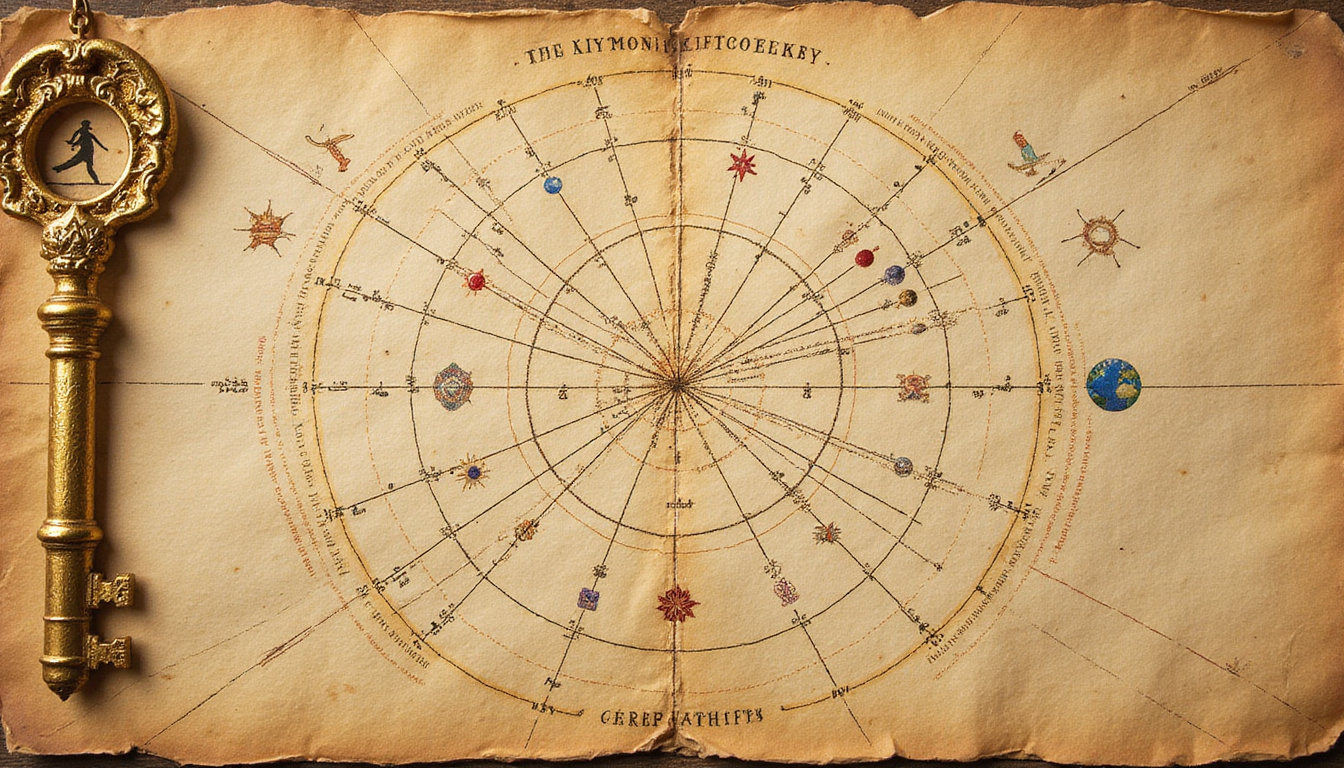
Major aspects:
- Conjunction (0°) – Planets merge; energy is intensified.
- Sextile (60°) – Easy opportunity, supportive but needs conscious use.
- Square (90°) – Tension, inner conflict that pushes growth.
- Trine (120°) – Natural talent, easy flow, sometimes taken for granted.
- Opposition (180°) – Polarity, projection, learning balance through others.
Example:
- Moon square Mars – Emotional reactions may be fiery; anger and neediness can clash, but can also fuel passion and courage once integrated.
- Sun trine Jupiter – Natural optimism and confidence; opportunities often arise more easily.
Understanding aspects helps you see why you might feel pulled in opposing directions or why some skills come so naturally.
Putting It Together: How to Read Your Own Chart
To apply these astrology basics to your own life, move through your chart step-by-step.
-
Identify your Big Three
- Note your Sun, Moon, and Rising signs.
- Reflect: Do these three already feel like “you”?
-
Check personal planets (Mercury, Venus, Mars)
- Mercury: How you think and speak
- Venus: What and whom you’re attracted to; your taste and values
- Mars: How you go after what you want
-
See which houses are crowded
- Several planets in one house = life focus there (e.g., 10th house cluster → big career themes).
-
Notice major aspects
- Look for conjunctions, squares, and oppositions involving personal planets.
- These often explain internal conflicts and relationship patterns.
-
Journal about patterns
- Ask: Where do I see this play out in real life?
- Which traits feel developed? Which feel underused or challenging?
You don’t need to master every detail right away. Start broad, then zoom in as your understanding grows.
Is Astrology Real? A Brief Note on Skepticism
From a strict scientific standpoint, astrology isn’t validated as a predictive or causal system in the way physics or chemistry is. Many scientists view it as a cultural or psychological framework rather than a hard science (source: American Psychological Association).
Yet millions of people use astrology as a reflective tool—similar to journaling, therapy prompts, or personality tests. Its value often lies in:
- Self-inquiry and language for subtle inner experiences
- Normalizing cycles of change and growth
- Encouraging introspection and personal responsibility
You’re free to treat it as symbolic, spiritual, archetypal, or just an intriguing lens for self-exploration.
Common Misconceptions About Astrology Basics
As you dive in, it helps to clear up a few myths:
-
“All Leos are the same.”
Your Sun sign is one piece; Moon, Rising, aspects, and houses dramatically change expression. -
“Astrology removes free will.”
Astrology describes tendencies and timing, not fixed destinies. How you respond is up to you. -
“I don’t act like my sign, so astrology is wrong.”
You might be more connected to your Moon or Rising, or your Sun might be heavily aspected by other planets, changing its flavor. -
“Compatibility is only about Sun signs.”
Real synastry compares whole charts—Moon, Venus, Mars, and aspects between charts are especially important in relationships.
Practical Ways to Use Astrology for Personal Growth
Astrology is most useful when it leads to action, not just labels. Some simple applications:
-
Self-awareness:
Use your chart to name patterns—like conflict styles (Mars), attachment needs (Moon, Venus), or work habits (Saturn, 6th/10th houses). -
Timing reflection:
Track transits (current planet positions) to notice when themes repeat (e.g., Saturn transits often coincide with responsibilities and restructuring). -
Career clarity:
Look at your 10th house, its ruling planet, and midheaven (MC) sign for themes around vocation, public image, and impact. -
Relationship insight:
Explore your 7th house and Venus/Mars placements to better understand your relational needs and patterns.
Astrology doesn’t solve problems for you, but it can spotlight the underlying dynamics so you can work with them more consciously.
FAQ: Astrology Basics and Birth Charts
1. How do I start learning astrology basics without getting overwhelmed?
Start with your Big Three—Sun, Moon, and Rising—and read about each separately first. Then gradually add Mercury, Venus, and Mars. Focus on just one or two new concepts at a time (like houses or aspects) rather than trying to memorize everything.
2. What can a basic birth chart reading really tell me?
Even a basic understanding of your Sun, Moon, Rising, and the signs of your personal planets can reveal: your emotional needs, communication style, love language, typical challenges, and areas where you’re naturally gifted. You don’t need advanced techniques for astrology basics to be insightful.
3. Are online tools accurate for reading beginner astrology basics?
Most reputable sites use accurate astronomical data for chart calculations, so the positions of planets, signs, and houses are generally reliable. The interpretation text is where quality varies. Use online interpretations as a starting point, then deepen your understanding with books, courses, or a professional astrologer.
Astrology doesn’t tell you who to be—it offers a mirror showing who you already are and how you might evolve more intentionally. By learning these astrology basics and exploring your birth chart, you gain language for your inner world, clarity about your patterns, and a deeper appreciation for your unique path.
If you’re ready to go beyond generic horoscopes and truly unlock your birth chart and personality secrets, pull up your chart today and walk through it with this guide. Then, when you’re ready for a deeper dive—into forecasting, relationship compatibility, or life purpose—consider booking a professional reading or taking a structured course. Your chart is a lifelong map; the sooner you learn to read it, the more confidently you can navigate your life.
This guide explored astrology and zodiac meanings. To discover the psychology, consciousness, and scientific perspectives behind spiritual beliefs, visit SpiritualMindScience.com.