If you’ve ever opened your chart on an app or website and felt lost in a maze of symbols and jargon, you’re not alone. An astrology glossary is your roadmap. With a clear set of definitions at your side, you can finally decode your birth chart in a way that feels grounded, empowering, and practical—rather than confusing or mystical beyond reach.
Below is a people-first, plain-language astrology glossary that explains the key terms you’ll see in most charts. Use it as a companion whenever you’re exploring your own placements or reading about astrology online.
Why an Astrology Glossary Actually Matters
Astrology can be incredibly insightful—but only if you understand the language. Every birth chart is made of three main layers:
- Planets – What energies or functions are active
- Signs – How those energies express themselves
- Houses – Where in life those energies show up
On top of this, you’ll see aspects, angles, nodes, and more. Learning these basic terms turns your chart from a mysterious wheel into a readable story about your patterns, potential, and personal timing.
Core Birth Chart Terms You Must Know
Birth Chart (Natal Chart)
Your birth chart (or natal chart) is a snapshot of the sky at the exact moment and place you were born. It maps where the planets were in the zodiac and across the 12 houses. This chart is the foundation of all personal astrology interpretations.
Zodiac
The zodiac is the 360° band of the sky divided into twelve 30° segments (signs). These signs are not the same as modern constellations; they’re a symbolic framework used in Western astrology (source: American Federation of Astrologers).
Sun Sign, Moon Sign, Rising Sign
- Sun Sign – The sign the Sun was in when you were born. Describes your core identity, ego, vitality, and what you’re growing into over your lifetime.
- Moon Sign – The sign the Moon was in when you were born. Speaks to your emotional needs, instincts, and how you experience safety and comfort.
- Rising Sign (Ascendant) – The sign on the eastern horizon at your birth. It describes your outward style, how others first perceive you, and how you approach new situations.
The 12 Zodiac Signs in Plain Language
Each sign has a basic element and modality that shape how it behaves.
Elements
- Fire – Aries, Leo, Sagittarius (inspiring, bold, active)
- Earth – Taurus, Virgo, Capricorn (grounded, practical, steady)
- Air – Gemini, Libra, Aquarius (social, mental, communicative)
- Water – Cancer, Scorpio, Pisces (emotional, intuitive, sensitive)
Modalities
- Cardinal – Initiators (Aries, Cancer, Libra, Capricorn)
- Fixed – Stabilizers (Taurus, Leo, Scorpio, Aquarius)
- Mutable – Adapters (Gemini, Virgo, Sagittarius, Pisces)
Short Sign Descriptions
- Aries – Direct, driven, pioneering, sometimes impulsive
- Taurus – Steady, sensual, comfort-loving, resistant to change
- Gemini – Curious, communicative, changeable, quick-thinking
- Cancer – Nurturing, protective, sensitive, home-oriented
- Leo – Warm, expressive, proud, creative, attention-seeking
- Virgo – Analytical, helpful, detail-focused, improvement-driven
- Libra – Harmonizing, relationship-focused, diplomatic, indecisive
- Scorpio – Intense, private, transformative, emotionally deep
- Sagittarius – Adventurous, philosophical, freedom-loving, blunt
- Capricorn – Ambitious, responsible, strategic, disciplined
- Aquarius – Independent, innovative, idealistic, unconventional
- Pisces – Compassionate, imaginative, porous, sometimes escapist
The Planets: What Each Symbol Represents
In any practical astrology glossary, planets are crucial. They tell you what is happening in your psyche and life.
Luminaries
- Sun – Identity, purpose, vitality, ego, “who I am”
- Moon – Emotions, intuition, habits, inner child, needs
Personal Planets
- Mercury – Mind, communication, learning, information processing
- Venus – Love, attraction, values, relationships, money, pleasure
- Mars – Drive, action, anger, sexuality, how you assert yourself
Social Planets
- Jupiter – Growth, luck, expansion, beliefs, optimism, faith
- Saturn – Limits, discipline, responsibility, structure, maturity
Outer (Transpersonal) Planets
- Uranus – Change, rebellion, innovation, awakening
- Neptune – Dreams, spirituality, imagination, illusions
- Pluto – Power, transformation, shadow, deep psychological change
The 12 Houses: Where Life Plays Out
Think of houses as different arenas of life. The same planetary energy will behave differently depending on what house it falls into.
-
1st House – Self & Identity
Appearance, personality, how you begin things, your approach to life. The sign here is your Rising Sign. -
2nd House – Money & Values
Personal finances, possessions, self-worth, what you value and prioritize. -
3rd House – Communication & Mind
Thinking style, learning, siblings, neighbors, everyday communication. -
4th House – Home & Roots
Family, home life, origins, private life, emotional foundation. -
5th House – Creativity & Pleasure
Romance, fun, hobbies, children, self-expression, risk-taking. -
6th House – Work & Health
Daily routines, jobs, co-workers, service, health habits. -
7th House – Partnerships
Long-term relationships, marriage, business partnerships, open enemies. -
8th House – Shared Resources & Transformation
Joint finances, debt, inheritances, intimacy, psychological depths, taboo topics. -
9th House – Beliefs & Exploration
Higher education, travel, philosophy, spirituality, law, worldview. -
10th House – Career & Legacy
Public image, reputation, career path, achievements, authority. -
11th House – Community & Future
Friends, groups, networks, social causes, long-term dreams. -
12th House – The Unseen & Inner World
Subconscious, spiritual life, solitude, hidden patterns, endings.
Aspects: How Planets Talk to Each Other
Aspects show how different parts of your psyche interact. You’ll see these all over a birth chart.
- Conjunction (0°) – Two planets side by side. They merge and amplify each other.
- Sextile (60°) – Supportive, easy flow of energy, potential that requires some effort.
- Square (90°) – Tension, conflict, friction that prompts growth and action.
- Trine (120°) – Natural harmony, talents that come easily and may be taken for granted.
- Opposition (180°) – Polarization, tug-of-war between two areas of life that need balance.
Angles & Key Points
Some chart points are especially powerful.
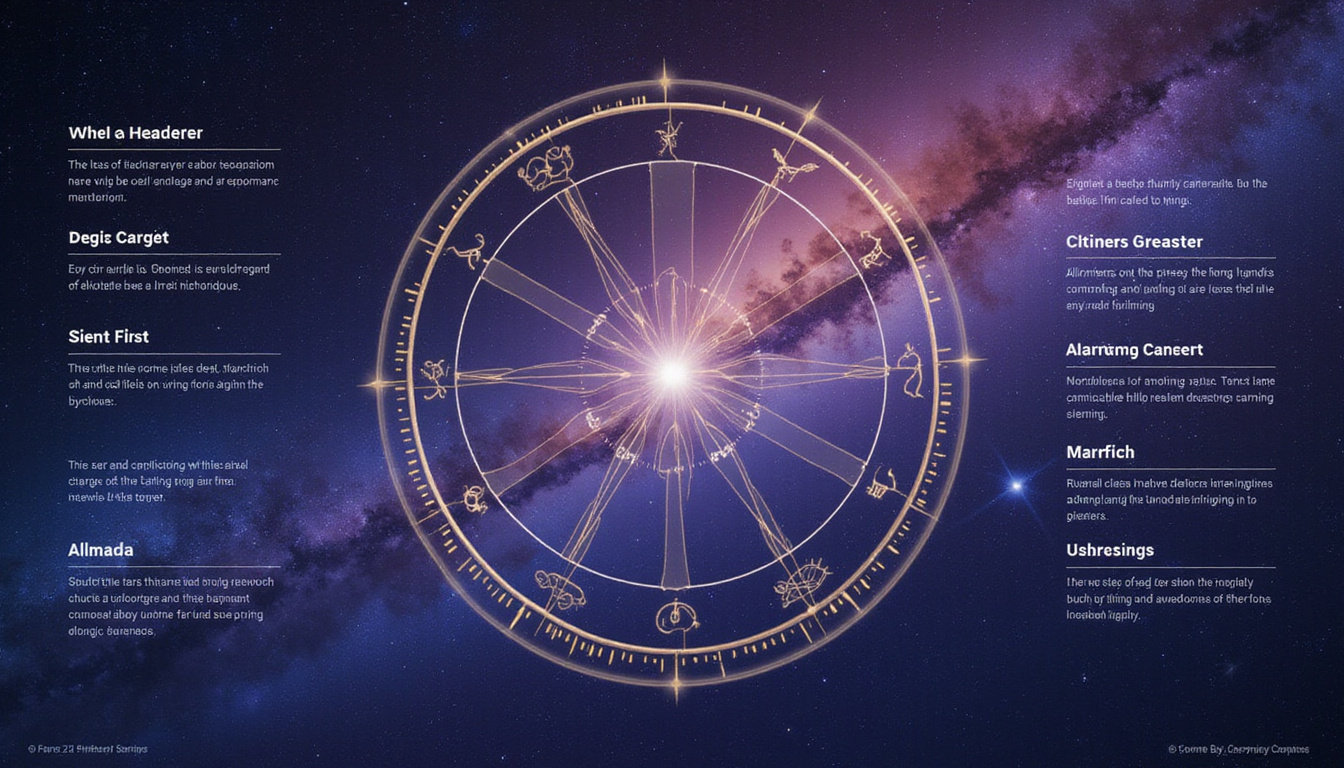
- Ascendant (AC) – Rising sign; your outer persona and life approach.
- Descendant (DC) – Opposite the Ascendant; describes your partnership style and what you seek in others.
- Midheaven (MC) – The top of the chart; public image, career direction, reputation.
- Imum Coeli (IC) – Bottom of the chart; your roots, family dynamics, inner foundation.
Nodes, Retrogrades, and Other Common Terms
A complete astrology glossary for beginners should also clarify these frequently confusing words:
- North Node – Symbolizes your soul growth and new territory in this lifetime. Feels unfamiliar but deeply meaningful.
- South Node – Past patterns, comfort zone, ingrained habits. Feels easy, but staying here alone can limit growth.
- Retrograde (Rx) – When a planet appears to move backward from Earth’s perspective. Symbolically, its themes turn inward for review, reflection, and revision.
- Transit – The current movement of planets in the sky as they interact with your birth chart. Used to forecast timing and themes.
- Progressions – A predictive technique where each day after birth represents a year of life; used to track inner development.
- Return (e.g., Saturn Return, Solar Return) – When a planet comes back to the exact point it occupied at your birth, marking key life cycles.
How to Use This Astrology Glossary to Read Your Own Chart
To put these definitions into action, follow a simple process:
- Find your chart – Use a reputable free chart calculator (search “natal chart calculator”) and enter your birth date, exact time, and place.
- Note your Big Three – Write down your Sun, Moon, and Rising sign.
- Check planetary placements – See which signs and houses each planet is in.
- Identify aspects – Look for conjunctions, squares, trines, etc., especially involving the Sun, Moon, Ascendant, Saturn, and outer planets.
- Connect the dots – Use this glossary to combine:
- Planet = what
- Sign = how
- House = where
For example:
“Mars (drive) in Gemini (curious, talkative) in the 3rd house (communication)” might describe someone who is energized by debate, quick conversations, and mentally stimulating tasks.
Quick Reference List: Essential Astrology Terms
Use this checklist-style list when scanning your chart:
- Birth/Natal Chart
- Sun Sign / Moon Sign / Rising Sign
- Zodiac Signs (Aries–Pisces)
- Elements & Modalities
- Houses 1–12
- Planets (Sun through Pluto)
- Aspects (conjunction, sextile, square, trine, opposition)
- Ascendant, Descendant, Midheaven, IC
- North Node, South Node
- Retrograde
- Transit
- Saturn Return
- Progressions
FAQ: Common Questions About Astrology Terms
What is an astrology dictionary or astrology terms list?
An astrology dictionary or astrology terms list is similar to this astrology glossary: a reference guide that defines the symbols, planets, houses, aspects, and other technical words used in charts. It helps you move beyond generic Sun-sign horoscopes and into more nuanced, personal interpretation.
How can a beginner use an astrology vocabulary guide to read a chart?
Start with a simple astrology vocabulary guide like this one and focus on your Sun, Moon, and Rising sign. Then add your Venus, Mars, and Saturn placements. Look up each planet, sign, and house combination, and read the aspect meanings. Over time, this turns into intuitive pattern recognition.
Where can I find a printable astrology glossary PDF?
Many reputable astrology websites and professional astrologers offer free or low-cost astrology glossary PDFs and cheat sheets. Search for “printable astrology glossary PDF” or check organizations like the American Federation of Astrologers and trusted online schools for downloadable materials.
Turn Definitions Into Insight: Your Next Step
You now have a clear, practical astrology glossary that can help you translate your chart from symbol-speak into everyday language. The real magic happens when you apply these definitions to your own life—your patterns in love, work, family, and growth.
Don’t let your chart sit as a confusing image on your screen. Pull it up, keep this guide beside you, and start decoding one piece at a time. When you’re ready to go deeper, you can explore more advanced aspects, timing techniques, or even consult a professional astrologer for personalized guidance.
Take the next step today: open your birth chart, grab this glossary, and begin turning vague curiosity into concrete, self-aware insight. Your chart doesn’t just describe who you are—it points to who you can become.
Want to understand the deeper meaning behind spiritual practices and beliefs? Visit SpiritualMindScience.com for science-informed spiritual education.