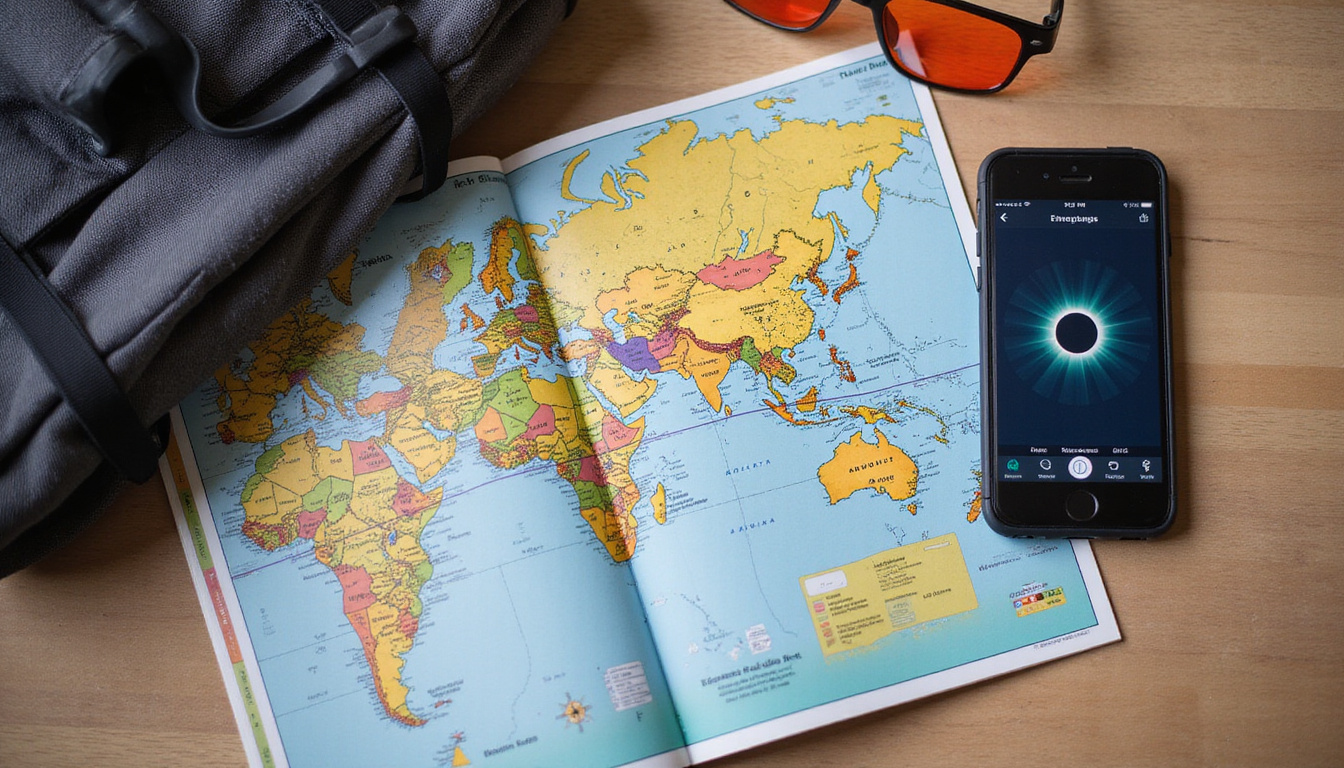
Eclipses have captivated human beings for thousands of years, inspiring myths, scientific breakthroughs, and unforgettable personal experiences. Whether you’re planning to travel to see future eclipses in person or simply want to understand what’s happening in the sky above your backyard, a bit of preparation can turn a few minutes of darkness into a life-long memory.
This guide breaks down where to watch eclipses, how to prepare safely and comfortably, and why these rare alignments matter scientifically, culturally, and personally.
What Exactly Is an Eclipse?
Astronomically, eclipses occur when one celestial body moves into the shadow of another.
There are two main types visible from Earth:
- Solar eclipses – The Moon moves between Earth and the Sun, casting a shadow on parts of Earth.
- Total solar eclipse: The Moon completely covers the Sun.
- Partial solar eclipse: The Moon covers only part of the Sun.
- Annular eclipse: The Moon is slightly farther from Earth and appears smaller, leaving a “ring of fire” of sunlight.
- Lunar eclipses – Earth moves between the Sun and the Moon, and Earth’s shadow darkens the Moon.
- Total lunar eclipse: The Moon passes fully into Earth’s umbra, often turning red (a “blood moon”).
- Partial lunar eclipse: Only part of the Moon passes through the darkest part of Earth’s shadow.
- Penumbral eclipse: The Moon passes through Earth’s lighter outer shadow, causing subtle dimming.
These alignments are only possible because the Sun, Moon, and Earth happen to appear roughly the same size in our sky—a remarkable cosmic coincidence.
Where to Watch Eclipses: Finding the Best Viewing Spots
The best place to watch eclipses depends on the type and the specific event. Not all eclipses are visible from everywhere, and solar eclipses in particular follow narrow paths.
Understanding the Path of Totality
For a total solar eclipse, only a slim track called the path of totality experiences complete darkness. Observers just outside that strip will see only a partial eclipse, even if they’re very close.
To find where a future eclipse will be visible:
- Use official mapping tools like NASA’s eclipse maps or the U.S. Naval Observatory (for global visibility details).
- Look up interactive maps that show:
- The path of totality or annularity
- Local times for maximum coverage
- Duration of totality or maximum eclipse
For lunar eclipses, the viewing area is much broader. Anyone on the night side of Earth at the time of the eclipse can usually see it, weather permitting.
Choosing an Ideal Eclipse Viewing Location
Once you know the path, refine your exact spot based on:
- Weather prospects: Look for regions with historically clear skies for the time of year (deserts, high plains, coastal areas with seasonal clarity).
- Light pollution: For lunar eclipses, darker skies improve the experience, especially for photography and stargazing before and after.
- Horizon views: Open horizons are especially helpful if the eclipse is near sunrise or sunset.
- Accessibility and comfort:
- Nearby parking or transport
- Access to restrooms and food
- Space to set up chairs, blankets, or tripods
- Crowds and infrastructure:
- Popular eclipse destinations can see heavy traffic, sold-out hotels, and congested cellular networks.
- Rural areas may offer better skies but fewer services; plan accordingly.
Many people choose:
- National or state parks
- High-elevation lookouts
- Fields or open countryside
- School or community fields organizing group viewings
How to Prepare for a Solar Eclipse
Solar eclipses demand careful preparation—both for safety and logistics.
Protecting Your Eyes: Safety First
Looking directly at the Sun without proper protection can permanently damage your eyes. This is true even when most of the Sun is covered.
Safe viewing options include:
- ISO-certified eclipse glasses: Look for ISO 12312-2 certification from reputable vendors. Use them anytime any part of the bright Sun is visible.
- Solar filters for cameras, telescopes, and binoculars: Never look through optical devices at the Sun without a proper solar filter over the front of the lens.
- Pinhole projectors: Create a simple projector with cardboard to view the Sun’s image safely on a surface.
- Welder’s glass: Only shade 14 is considered safe, and it should be from a trusted source.
The only time it is safe to look at the Sun without eye protection is during the brief totality phase of a total solar eclipse, when the Sun is entirely covered. The moment even a sliver of Sun reappears, eye protection must go back on.
Authoritative safety guidance is provided by NASA and organizations like the American Astronomical Society (source: NASA Eclipse Safety).
What to Pack for a Solar Eclipse Trip
A little gear transforms a good eclipse into a great one, especially if you’re traveling.
Consider bringing:
- Eclipse glasses (plus extras—people forget or damage theirs)
- Sunscreen, hat, and sunglasses (for before and after eclipse)
- Folding chairs or a blanket
- Water and snacks or a full meal if you’ll be in place for hours
- Extra clothing layers (temperatures can drop during totality)
- Binoculars with solar filters (for pre- and post-totality)
- A small first-aid kit
- Printed maps or directions in case of poor cell coverage
- Portable battery packs for phones and cameras
If you’re photographing the eclipse, add:
- DSLR or mirrorless camera with telephoto lens (200mm or longer is ideal)
- Sturdy tripod
- Solar filter for the lens
- Remote shutter release or intervalometer
- Pre-set camera settings and a checklist to avoid panic during totality
How to Prepare for a Lunar Eclipse
Lunar eclipses are more forgiving: they’re safe to view with the naked eye, binoculars, or telescopes—no special filters needed.
To prepare:
- Check the timing (start, maximum, and end of eclipse) in your local timezone.
- Choose a dark-sky location if possible, away from bright streetlights.
- Bring:
- A reclining chair or blanket
- Warm clothing (lunar eclipses often occur late at night or early morning)
- Binoculars or a telescope for a closer look at lunar features
- For photography:
- A camera with manual settings
- Tripod
- Telephoto or telescope adapter
- Remote shutter or self-timer to avoid shake
Because lunar eclipses unfold over hours, they offer a more relaxed, social viewing experience than the frantic few minutes of a total solar eclipse.
Timing Your Eclipse Experience
Eclipse timing isn’t just about the final moment of totality or maximum coverage. The entire sequence is worth following.
For solar eclipses, you’ll typically experience:
- First contact – The Moon’s disk appears to take a “bite” out of the Sun.
- Partial phase – The Sun becomes progressively more crescent-shaped.
- Totality (if in path) – The sky darkens dramatically; stars and planets may appear; temperature drops.
- End of totality – A flash of sunlight (“diamond ring” effect) signals the Sun’s return.
- Final partial phase – The crescent Sun expands until full daylight resumes.
For lunar eclipses, the phases include:
- Penumbral shading (subtle darkening)
- Partial umbral eclipse (visible “bite” in the Moon)
- Totality (Moon appears dark red or copper)
- Reversal of phases as the Moon exits Earth’s shadow
Use local astronomy apps or observatory websites for precise times at your location.
Why Eclipses Matter: Science, Culture, and Personal Impact
Eclipses are more than stunning sky shows. They’ve shaped science, culture, and many individual life paths.
Scientific Significance
Historically, solar eclipses have:
- Helped confirm Einstein’s theory of general relativity (starlight bending around the Sun was measured during a 1919 eclipse).
- Enabled detailed studies of the Sun’s corona, normally hidden in the Sun’s glare.
- Contributed to our understanding of the Sun’s magnetic fields and solar wind.
Lunar eclipses help refine orbital models and provide opportunities to study Earth’s shadow and atmosphere (the red color comes from sunlight refracted through our atmosphere).
Cultural and Historical Meaning
Across civilizations, eclipses have:
- Been interpreted as omens, divine messages, or signs of change.
- Motivated the construction of ancient observatories and calendar systems.
- Inspired art, literature, and religious rites.
Today, they often become community events and educational opportunities, bringing together scientists, teachers, and families under the same sky.
Personal and Emotional Experience
Many eclipse chasers describe their first total solar eclipse as life-changing:
- A sudden sense of cosmic scale and perspective
- Emotional reactions—from tears to stunned silence
- Renewed interest in science, astronomy, and nature
- Shared awe that bridges language and cultural barriers
Even if you never become a dedicated eclipse hunter, witnessing a major eclipse with intention—prepared and present—can be one of the most powerful natural experiences of your life.
Common Mistakes to Avoid During Eclipses
To make your viewing as smooth and safe as possible, watch out for these pitfalls:
- Neglecting eye safety during solar eclipses or assuming sunglasses are sufficient.
- Arriving late and missing the slower, fascinating lead-up phases.
- Underestimating traffic and crowds in popular viewing areas.
- Ignoring weather forecasts and failing to have a backup viewing location.
- Spending the entire event behind a camera, and not taking a few moments just to look (safely) and feel the experience.
A good rule: once you’ve captured a few photos, put the gear down and simply watch for at least part of the event.
Quick Eclipse Planning Checklist
Use this short checklist as a starting point when preparing for upcoming eclipses:
- Check if the eclipse will be visible from your region.
- Identify the best location within the visibility path.
- Review long-term weather patterns and current forecasts.
- Secure travel and accommodation early if needed.
- Acquire proper eclipse glasses or viewing equipment.
- Plan arrival time, return route, and backup sites.
- Pack comfort items: seating, clothing layers, water, and food.
- Inform friends or family and consider viewing as a group.
- Review safety rules with children or first-time viewers.
- Decide whether to photograph or just observe—and plan accordingly.
FAQ About Eclipses
1. What causes solar and lunar eclipses to happen when they do?
Solar and lunar eclipses occur when the Sun, Earth, and Moon line up closely enough for one body to cast a shadow on another. Because the Moon’s orbit is tilted about 5 degrees relative to Earth’s orbit around the Sun, most new and full Moons don’t result in an eclipse; exact alignment happens only a few times a year.
2. How often do total eclipses occur in the same place on Earth?
While eclipses themselves are fairly frequent worldwide, total solar eclipses are rare for any single spot. On average, one location may experience totality only once every 300–400 years. Lunar eclipses are more common to see from a given region, since half the Earth can view them at once.
3. Are eclipses dangerous to watch?
Lunar eclipses are not dangerous at all and can be viewed safely with the naked eye. Solar eclipses, however, can be hazardous if observed improperly. Looking at the Sun without appropriate eclipse glasses or solar filters can permanently damage your eyes, even during partial phases. Following established safety guidelines makes solar eclipse viewing safe.
Make Your Next Eclipse Unforgettable
Eclipses are among the most dramatic reminders that we live on a moving planet in a dynamic cosmic neighborhood. With a bit of planning—choosing the right place to watch, preparing safe viewing gear, and understanding why these events are so significant—you can transform a brief alignment of Sun, Moon, and Earth into a profound personal moment.
Start now: look up the next solar and lunar eclipses visible from your area, mark your calendar, and invite friends or family to share the experience. With each eclipse you witness, you don’t just watch the sky change; you deepen your connection to the universe we all share.
Learn how astronomy, psychology, and spiritual traditions intersect by visiting SpiritualMindScience.com for deeper insights.