If you’ve ever wondered how seasoned skywatchers seem to “magically” know when the next bright comet, asteroid occultation, or perfect ISS pass will occur, the answer usually comes down to one powerful tool: the ephemeris. Learn to read and use an ephemeris, and you’ll unlock the ability to predict celestial events with precision, plan your sessions like a pro, and get far more out of every night under the stars.
What Is an Ephemeris, Really?
At its core, an ephemeris is a table or dataset that lists the predicted positions of astronomical objects at specific times. Instead of hunting blindly for a planet or asteroid, you consult an ephemeris and know exactly where to point your binoculars or telescope.
Modern ephemerides can cover:
- Planets and the Moon
- Dwarf planets and asteroids
- Comets
- Artificial satellites (including the ISS)
- Eclipses, transits, and occultations
Historically, astronomers relied on printed ephemeris books. Today, most of us use online tools or apps that generate ephemeris data on the fly for any location on Earth.
Why Ephemerides Are Essential for Observers
Using an ephemeris is like having a weather forecast for the sky’s geometry. Instead of just knowing what’s “up,” you know where, when, and how to look.
Key benefits for visual observers and imagers include:
- Pinpoint positioning – Find faint objects that aren’t obvious by star-hopping alone.
- Perfect timing – Catch fleeting events like eclipses, shadow transits, or lunar grazes down to the minute or even second.
- Efficient planning – Schedule sessions when targets are highest and conditions best, rather than wasting time on objects still low in the murk.
- Better images – Frame targets with the Moon, planets, or foreground scenery because you know their paths in advance.
If you want to move beyond casual skywatching and toward intentional, high-yield observing, learning to work with an ephemeris is a foundational skill.
The Core Elements of an Ephemeris (and What They Mean)
Open a planetary or asteroid ephemeris, and you’ll see a dense block of data for each time step. Once you understand the key elements, it becomes far less intimidating.
Most visual observers focus on:
-
Date and Time
- Often in Universal Time (UT) or Terrestrial Time (TT). Apps usually convert to your local time automatically.
-
Right Ascension (RA) and Declination (Dec)
- The celestial equivalent of longitude and latitude.
- RA is measured in hours, minutes, seconds; Dec in degrees, arcminutes, arcseconds.
- These are the coordinates you enter into a GoTo mount or use with star charts.
-
Altitude and Azimuth
- Altitude: angle above the horizon (0° = horizon, 90° = directly overhead).
- Azimuth: direction along the horizon (0°/360° = North, 90° = East, 180° = South, 270° = West).
- Ideal observing is often when altitude > 30° to avoid thick atmosphere.
-
Magnitude (Brightness)
- Lower numbers are brighter (e.g., Venus at –4 is bright; +10 is faint).
- Helps you judge whether binoculars, a small scope, or a big Dobsonian is needed.
-
Distance
- Often in astronomical units (AU) for planets and comets, or kilometers for satellites.
- Useful for understanding why an object is unusually bright, large, or fast-moving.
-
Phase / Illumination (for Moon and planets)
- Shows how much of the disk is lit and the phase angle.
- Crucial for planning crescent Moons, crescent Venus, or thin-limbed lunar features.
Once you can quickly parse these columns, you can translate ephemeris data into specific, actionable observing plans.
How to Use an Ephemeris to Plan a Night Under the Stars
Here’s a step-by-step way to put an ephemeris to work for a single observing session.
1. Set Your Location and Time Range
In any ephemeris tool or app, start by:
- Entering your exact location (latitude, longitude, and elevation if possible).
- Selecting your time zone and date.
- Choosing a time step (e.g., every 1 hour, every 10 minutes, or single specific times).
Accurate coordinates are vital. The same celestial event’s visibility can change dramatically over just a few hundred kilometers.
2. Generate Ephemeris Data for Your Targets
Pick what you want to observe:
- Planets and the Moon
- A specific asteroid or comet
- A satellite like the ISS
- The Sun for sunspot observing (with appropriate filters)
Then generate an ephemeris for those objects for your chosen night, usually over a time block such as 20:00–02:00 local time.
3. Identify the Best Observing Windows
From the ephemeris, look for:
- Maximum altitude – When the object is highest above the horizon (transit time).
- Brightness peaks – Nights when magnitude is lowest (brightest).
- Visibility windows – Periods when the object is above, say, 20°–30° altitude and the sky is dark.
For example, if Jupiter’s altitude peaks at 60° at 01:30, that’s your prime time for high-resolution planetary observing.
4. Match Equipment and Targets
Use the magnitude and altitude from the ephemeris to pick tools and exposure strategies:
- Bright planets at high altitude: perfect for high power and planetary imaging.
- Faint galaxies at modest altitude: better with larger apertures and low power.
- Rapidly moving satellites: favor wide fields and fast exposures.
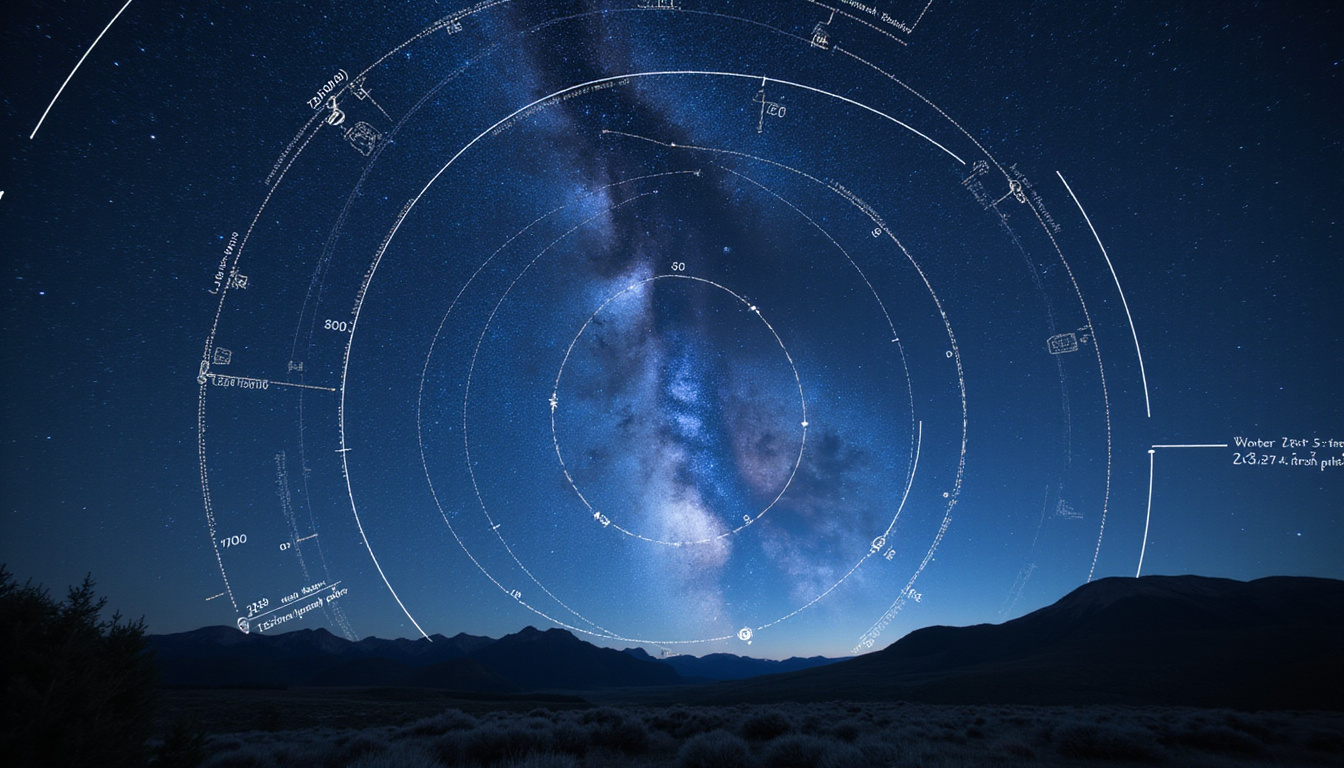
With ephemeris data, you can also plan sequences, such as imaging a nebula early in the evening, then switching to planets at transit, and finishing with clusters rising toward dawn.
5. Create a Simple Observing Timeline
Turn data into a real-world plan. For instance:
- 21:00–22:00 – Observe Saturn as it climbs above 30°.
- 22:00–23:00 – Switch to a comet near its highest altitude.
- 23:30–01:30 – Focus on Jupiter and its moon transits (times from ephemeris).
- 01:30–02:30 – Wide-field imaging of the Milky Way as it crosses the meridian.
Your ephemeris becomes the backbone of a practical, efficient observing schedule.
Top Tools for Accessing Ephemerides
You don’t need to calculate an ephemeris yourself. A wide range of high-quality tools are available, often free.
- NASA JPL Horizons – Gold standard online ephemeris system for planets, asteroids, and comets (source: NASA JPL Horizons).
- Minor Planet Center (MPC) – Ephemeris services for asteroids and comets.
- Heavens-Above – Satellite and ISS prediction tailored to your location.
- Planetarium software – Stellarium, SkySafari, Cartes du Ciel, and similar tools generate ephemeris-style details from interactive sky maps.
- Mobile apps – Many astronomy apps provide an ephemeris view, showing altitude, azimuth, and other data over time.
For most amateur observers, a combination of a planetarium app plus an external resource like Horizons or Heavens-Above covers nearly every need.
Advanced Uses: Going Beyond Basic Position Predictions
Once you’re comfortable with a standard ephemeris, you can dive into more specialized applications.
Predicting Eclipses and Planetary Transits
Solar and lunar eclipse circumstances—contact times, magnitude, and duration—are all driven by ephemeris calculations. With the right tools, you can:
- Find local start, maximum, and end times.
- See which part of the eclipse path you’re in.
- Plan travel to the center line for totality or annularity.
Similarly, for planetary transits (like Mercury or Venus across the Sun), an ephemeris ensures you’re set up and ready well before first contact.
Lunar and Asteroid Occultations
Occultations—where one object passes in front of another—can be among the most scientifically valuable events for amateurs.
Using an ephemeris, you can:
- Predict when the Moon will occult a bright star from your site.
- Determine if an asteroid will pass in front of a star and whether your observing location falls in the event path.
- Plan high-speed timing to refine asteroid sizes and shapes.
Organizations like the International Occultation Timing Association (IOTA) publish detailed occultation ephemerides you can tailor to your location.
ISS and Satellite Flyovers
For satellites, an ephemeris includes:
- Precise path across your sky (azimuth/altitude over time).
- Brightness estimates (magnitude).
- Special events like ISS solar transits or Iridium-style flares for certain satellites.
Knowing the exact time and path lets you frame astrophotography shots with satellites streaking past constellations or landmarks.
Practical Tips to Get More Out of Ephemerides
To turn ephemeris data into better observing experiences, keep these practical pointers in mind:
-
Always check your time zone and daylight saving settings.
Misconfigured time converts are the most common source of “missed” events. -
Use local horizon masks when possible.
Trees and buildings can invalidate “above-horizon” predictions; allow a few extra degrees in altitude limits. -
Favor meridian transit times for critical observations.
That’s when objects are highest, sharpest, and least affected by atmospheric turbulence. -
Cross-check with a planetarium app.
Visual confirmation on a star chart helps translate ephemeris numbers into mental sky maps. -
Export and print or save to your phone.
Don’t rely solely on an internet connection at a dark site; have offline copies of your key ephemeris data.
FAQ: Common Questions About Ephemerides
What is an astronomical ephemeris used for?
An astronomical ephemeris is used to predict the positions and other characteristics (like brightness and altitude) of celestial objects at specific times. Observers use it to plan when and where to look for planets, comets, asteroids, eclipses, occultations, and satellite passes, increasing the chances of successful observations and images.
How do I read an ephemeris for planets and comets?
To read a planetary ephemeris or a comet ephemeris, focus on the columns for date/time, RA/Dec, altitude/azimuth, and magnitude. Check the times when altitude is highest and magnitude is lowest (brightest). These represent the best viewing windows. Use RA/Dec with charts or GoTo mounts, and altitude/azimuth to confirm where in the sky to look.
Where can I get accurate ephemeris data online?
Accurate online ephemeris data is available from several authoritative sources. NASA’s JPL Horizons system is widely regarded as one of the most precise for planets, asteroids, and comets. The Minor Planet Center and Heavens-Above offer specialized ephemerides for small bodies and satellites. Many planetarium programs and mobile apps also use high-quality ephemeris models under the hood.
Turn Ephemeris Knowledge into Real Observing Success
Understanding and using an ephemeris turns the night sky from a static backdrop into a dynamic, predictable theater of motion. Instead of hoping to stumble upon something interesting, you’ll know exactly what is happening, where it is, and when you need to be outside to see it.
Start with one target—perhaps Jupiter, the Moon, or the ISS—and generate an ephemeris tailored to your location and an upcoming clear night. Build a simple schedule from that data and follow it at the telescope. After one or two nights of “ephemeris-powered” observing, you’ll never want to go back to guesswork.
If you’re ready to boost your observing, choose your favorite ephemeris tool, plug in your coordinates, and plan your next session today. Every remarkable transit, occultation, or perfect planetary view you catch from now on will be the direct payoff of mastering this essential astronomical tool.
Curious about why astrology has fascinated people for centuries? Explore evidence-based perspectives on spirituality, consciousness, and human psychology at SpiritualMindScience.com