From the motions of planets in our solar system to the swirling arms of distant spiral galaxies, gravitational influence is the hidden architect of cosmic structure. Yet, when astronomers tried to explain how galaxies move and hold together, visible matter alone did not add up. Something unseen—dark matter—had to be exerting an enormous gravitational pull, silently shaping the destiny of galaxies and the universe itself.
In this article, you’ll see how gravity works on galactic scales, why dark matter was proposed, and how its gravitational influence governs the life cycle of galaxies.
Gravitational Influence: From Everyday Experience to Cosmic Scales
Gravity is the attractive force between objects with mass. On Earth, you feel its influence as weight; on cosmic scales, gravitational influence determines orbits, galaxy shapes, and even the growth of cosmic structure after the Big Bang.
At its simplest, Newton’s law of universal gravitation says:
- The gravitational force increases with mass.
- The force decreases rapidly with distance (inversely proportional to the square of the distance).
Later, Einstein’s General Relativity refined this picture: massive objects curve spacetime, and what we perceive as gravitational influence is matter following the straightest possible paths in this curved geometry.
In everyday life, that curvature is tiny. In galaxies and clusters of galaxies, it’s profound—especially when we include dark matter, which interacts primarily through gravity.
The Galactic Puzzle: Why Gravity Alone Didn’t Add Up
By the early 20th century, astronomers could measure how fast stars and gas clouds orbit the centers of their galaxies. According to classical expectations:
- Matter should be concentrated near the center.
- Stars farther from the center should orbit more slowly, much like distant planets move more slowly around the Sun.
But observations showed something very different.
Flat Rotation Curves: A Key Clue
In spiral galaxies, astronomers found that:
- The orbital speeds of stars and gas do not drop off with distance.
- Beyond a certain radius, speeds stay roughly constant—creating “flat rotation curves.”
If only visible matter (stars, gas, and dust) contributed to gravitational influence, the outer stars should move much more slowly or even fly away. They don’t. Therefore, there must be extra unseen mass extending far beyond the visible disk, providing additional gravitational pull.
This was one of the strongest early hints that our understanding of galactic mass—and hence gravitational influence—was incomplete.
What Is Dark Matter?
Dark matter is a form of matter that:
- Does not emit, absorb, or reflect light (hence “dark”).
- Interacts very weakly, if at all, through electromagnetism.
- Exerts strong gravitational influence, detected through its effects on visible matter, radiation, and spacetime.
Dark matter is not:
- Ordinary dark objects like black holes, cold gas, or faint stars (there isn’t nearly enough of those to explain observations).
- Antimatter or any known particle in the Standard Model of particle physics.
The leading idea is that dark matter is made up of as-yet-undiscovered particles produced in the early universe. According to measurements of the cosmic microwave background and large-scale structure, dark matter makes up about 27% of the universe’s energy content, while normal matter is only about 5% (source: NASA – Dark Matter).
Dark Matter Halos: Invisible Scaffolding for Galaxies
Galaxies don’t just float alone in space; they are embedded in enormous, roughly spherical envelopes of dark matter called dark matter halos.
How Halos Shape Galactic Structure
A typical galaxy sits near the center of its dark matter halo, which:
- Extends far beyond the visible disk or bulge.
- Contains more total mass than all the galaxy’s stars and gas combined.
- Dominates the galaxy’s overall gravitational influence at large radii.
Because the halo’s mass is spread out over a huge volume, it provides the extra gravitational pull necessary to keep outer stars and gas in their orbits, explaining the flat rotation curves.
The properties of these halos—such as their density profile and total mass—directly influence:
- How large a galaxy can become.
- How fast stars orbit at different distances.
- How easily gas can cool and form new stars.
How Gravitational Influence Guides Galactic Formation
Dark matter’s gravitational influence was crucial long before galaxies existed.
From Early Fluctuations to Cosmic Web
Right after the Big Bang, the universe was almost uniform but not perfectly so. Tiny density fluctuations existed in the sea of dark matter and normal matter. Because dark matter dominates gravity:
- Slightly denser regions of dark matter exerted stronger gravitational influence.
- They pulled in more matter, growing larger over time.
- These growing dark matter “clumps” became the seeds of future galaxies and galaxy clusters.
Over billions of years, dark matter collapsed into a vast cosmic web:
- Dense nodes: where dark matter halos formed and galaxies clustered.
- Filaments: strands of dark matter connecting these nodes.
- Voids: large regions with relatively little matter.
Normal (baryonic) matter—gas that can cool and form stars—fell into these dark matter wells, leading to the galaxies and clusters we see today.
Galactic Rotation Curves: Direct Evidence of Hidden Mass
One of the clearest ways to “see” the gravitational influence of dark matter is by measuring rotation curves—how orbital speed changes with distance from the galactic center.
What We’d Expect Without Dark Matter
If a galaxy’s mass were concentrated where we see stars and gas:
- Inside the visible disk: speeds would rise as you approach regions with more enclosed mass.
- Outside the main mass distribution: speeds should gradually fall with distance (like planets in the solar system).
What We Actually Observe
When astronomers map rotation curves using starlight and radio signals from hydrogen gas, they find:
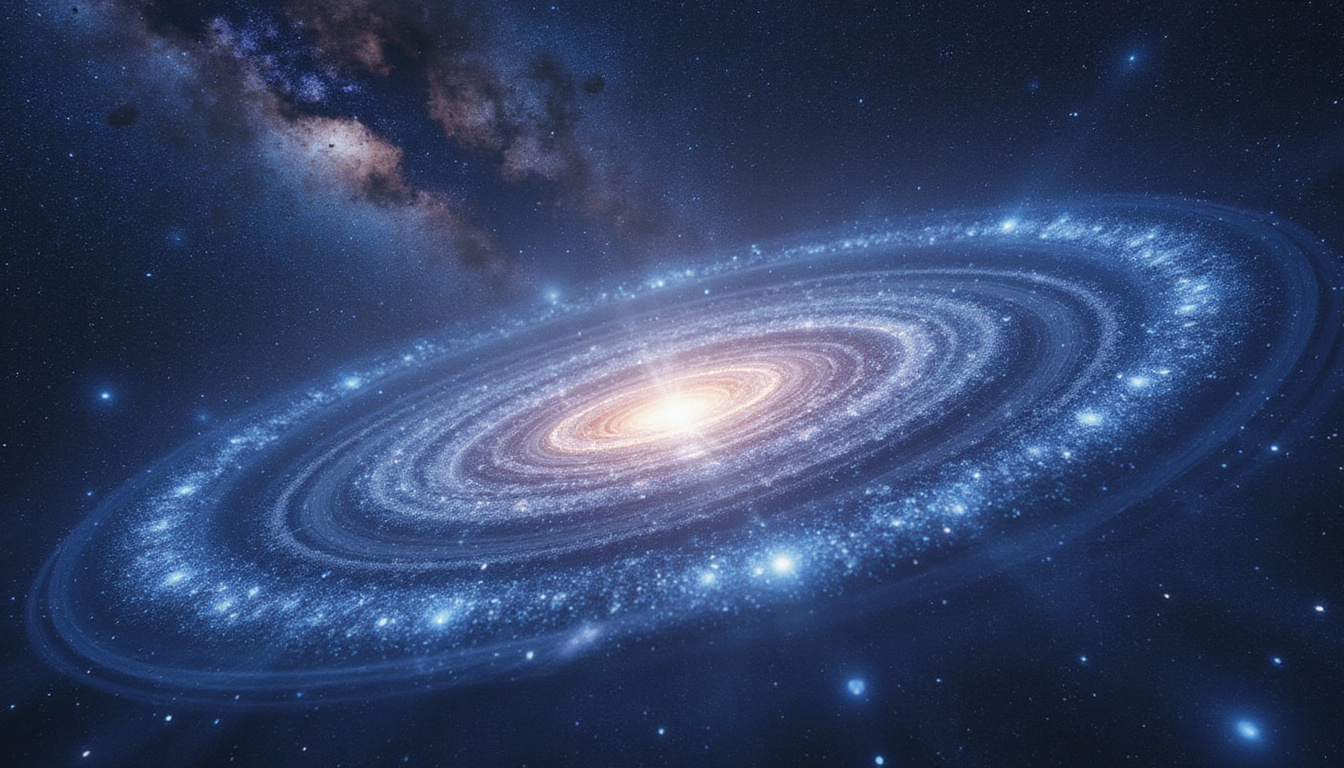
- Speeds rise near the center and then level off.
- The outer parts of galaxies orbit at almost the same speed as regions closer in.
- This holds true out to radii where there’s very little visible matter.
The only way to reconcile this with gravitational physics is to assume a massive, extended component: the dark matter halo. Its gravitational influence is what keeps galaxies from flying apart.
Gravitational Lensing: Seeing Dark Matter’s Shadow
Another powerful probe of dark matter’s gravitational influence is gravitational lensing.
How Lensing Works
General Relativity predicts that mass bends the path of light. When light from a distant galaxy passes near a massive object (like a galaxy cluster), the mass acts as a “lens,” warping and magnifying the background light.
By measuring:
- Distortions in the shapes of many background galaxies (weak lensing).
- Multiple images, arcs, or rings of a single background source (strong lensing).
Astronomers can reconstruct how mass is distributed along the line of sight.
What Lensing Reveals
These reconstructions consistently show:
- Far more mass than can be accounted for by stars and gas alone.
- Smooth, extended halos of mass around galaxies and clusters.
- Dark matter sometimes separated from the visible matter after cosmic collisions (e.g., the Bullet Cluster), strongly suggesting that an unseen, collisionless component is carrying much of the mass.
In other words, we can “map” dark matter by following its gravitational influence on light itself.
Galactic Interactions and Mergers Under Dark Matter’s Grip
Galaxies are not static islands; they frequently interact, collide, and merge under their mutual gravitational influence. Dark matter plays a key role in how these cosmic dances unfold.
Tidal Forces and Morphological Transformation
When two galaxies pass close by:
- Their dark matter halos overlap and tug on each other.
- Tidal forces can distort galactic shapes, pulling out long tidal tails of stars and gas.
- Over time, friction-like effects (dynamical friction) slow down their relative motion, often leading to a merger.
The mass and structure of the dark matter halos strongly influence:
- How quickly galaxies merge.
- How much their shapes are transformed (e.g., spiral galaxies turning into ellipticals).
- How efficiently gas is funneled into the center, triggering starbursts and feeding central black holes.
Without the extra mass and gravitational influence of dark matter halos, these processes would look very different and be less efficient.
Dark Matter and the Fate of Galaxies
Dark matter doesn’t just help build galaxies; it also affects their long-term evolution.
Star Formation and Gas Retention
A massive dark matter halo:
- Deepens a galaxy’s gravitational well, helping it retain gas against feedback processes (like supernova explosions and black hole jets).
- Allows gas to cool and sink into the central regions where it can form new stars.
- Shields small galaxies somewhat from losing all their gas to environmental effects in clusters.
Conversely, galaxies with shallow gravitational wells (often in small halos):
- Can have their gas blown out more easily.
- May struggle to form many stars, becoming faint “dwarf” galaxies.
Large-Scale Destiny: Expansion vs. Collapse
On the largest scales, the fate of the universe is governed by the interplay of:
- Dark matter’s gravitational influence, which pulls structures together.
- Dark energy’s repulsive effect, which accelerates cosmic expansion.
Current evidence suggests that dark energy dominates, so the universe’s expansion is accelerating. Galaxies and clusters bound by dark matter will remain gravitationally connected, but distant structures will drift beyond each other’s observable horizons over trillions of years.
Key Ways Dark Matter’s Gravitational Influence Shapes Galaxies
To summarize the central roles of dark matter in galactic destiny:
- Seeds structure formation by amplifying small density fluctuations after the Big Bang.
- Forms dark matter halos that act as gravitational wells where galaxies can form.
- Explains flat rotation curves by providing extra mass beyond visible edges of galaxies.
- Drives gravitational lensing patterns that reveal hidden mass distributions.
- Regulates galaxy mergers and interactions through the dynamics of overlapping halos.
- Controls star formation efficiency by determining how easily galaxies can retain gas.
- Helps build the cosmic web, the large-scale pattern of filaments, nodes, and voids.
All of this flows from one core concept: where there is dark matter, there is additional gravitational influence, and where gravity leads, galaxies follow.
FAQ: Gravitational Influence and Dark Matter
Q1: How does gravitational influence reveal dark matter if we can’t see it?
Astronomers infer dark matter by measuring gravitational influence on visible matter and light—such as galaxy rotation speeds, galaxy cluster dynamics, and gravitational lensing distortions. When the observed motions or light-bending require more mass than we can see, the extra mass is attributed to dark matter.
Q2: Is gravitational influence different for dark matter and normal matter?
No. As far as we know, dark matter and normal (baryonic) matter experience gravity in the same way. The difference is that dark matter doesn’t interact with light or most other forces, so its presence is known almost entirely through its gravitational influence.
Q3: Can modified gravity theories replace dark matter’s gravitational influence?
Some theories propose modifying gravity itself to explain galactic motions without dark matter. While they can sometimes fit specific phenomena (like rotation curves), they generally struggle to explain the full range of observations—especially gravitational lensing and the cosmic microwave background—as successfully as dark matter models do.
Your Next Step: Explore the Universe Through Gravity’s Lens
Every galaxy in the night sky is a testament to invisible forces at work. By following gravitational influence, astronomers have uncovered the existence of dark matter, mapped its halos, and traced the cosmic web that binds the universe together. Yet we still don’t know what dark matter actually is at the particle level.
If this glimpse into how dark matter shapes galactic destiny has sparked your curiosity, keep going:
- Dive into resources from NASA, ESA, or major observatories to see real data and simulations.
- Follow current dark matter experiments and surveys, where each new result refines our view of the cosmos.
- Share what you’ve learned—teaching others is one of the best ways to deepen your own understanding.
The universe is still revealing its secrets. Let gravity be your guide, and keep exploring how its unseen hand sculpts everything from the smallest galaxies to the vast cosmic web.
Learn how astronomy, psychology, and spiritual traditions intersect by visiting SpiritualMindScience.com for deeper insights.