A lunar eclipse is one of the easiest and most awe‑inspiring celestial events you can see with the naked eye. Unlike many astronomical phenomena, it doesn’t require expensive equipment or expert skills—just clear skies, basic planning, and a bit of understanding. This guide walks you through what a lunar eclipse is, how to watch it safely, how to photograph it (even with a smartphone), and how to appreciate the science and mythology behind it.
What Is a Lunar Eclipse?
A lunar eclipse happens when the Earth moves directly between the Sun and the Moon, casting its shadow on the Moon. This can only occur during a full moon, when the Moon is opposite the Sun in our sky.
There are three main types:
-
Penumbral Lunar Eclipse
The Moon passes through Earth’s penumbra (the lighter, outer part of the shadow). The dimming is subtle and can be hard to notice without careful observation or photography. -
Partial Lunar Eclipse
Only part of the Moon passes through Earth’s umbra (the darker, central shadow), so you see a “bite” taken out of the lunar disk. -
Total Lunar Eclipse
The entire Moon passes into Earth’s umbra. During totality, the Moon often turns a reddish or copper color—the famous “Blood Moon.”
The reddish color occurs because Earth’s atmosphere bends and filters sunlight into the shadow, scattering blue light and letting red and orange wavelengths reach the Moon, similar to how sunrises and sunsets look red on Earth (source: NASA).
When Is the Next Lunar Eclipse?
Lunar eclipses occur at least twice a year somewhere on Earth, but not every event is visible from every location. Visibility depends on your position on Earth and the timing of the eclipse phases.
To find out when the next lunar eclipse will be visible from your area:
- Check reputable astronomy sites (e.g., NASA, timeanddate.com, local observatories).
- Search “lunar eclipse [year] visibility map” to see global maps.
- Use astronomy apps that show eclipse paths and timing in your local time zone.
Key Timing Terms
When planning, you’ll see these phases listed:
- Penumbral Eclipse Begins (P1) – Moon enters Earth’s penumbra; dimming is very subtle.
- Partial Eclipse Begins (U1) – The umbra starts to cover the Moon; a dark “bite” appears.
- Totality Begins (U2) – For a total lunar eclipse, this is when the Moon is fully in the umbra and becomes red.
- Maximum Eclipse – The midpoint of the eclipse; the deepest shadow.
- Totality Ends (U3) – Moon begins to leave the umbra.
- Partial Eclipse Ends (U4) – The last part of the umbra moves off the Moon.
- Penumbral Eclipse Ends (P4) – Moon fully exits Earth’s shadow.
How to Watch a Lunar Eclipse Safely and Comfortably
Unlike solar eclipses, a lunar eclipse is completely safe to watch with the naked eye. You don’t need eclipse glasses or filters.
Best Practices for Viewing
-
Find a dark, open location
A spot with minimal light pollution and a clear view of the sky is ideal—parks, fields, rooftops (where allowed and safe), or beaches. -
Check the Moon’s altitude and direction
Use an app or online ephemeris to see where the Moon will be in the sky (e.g., southeast, high overhead) at the time of maximum eclipse. -
Bring basic gear
- A reclining chair or blanket
- Warm clothing (nights can get chilly)
- Snacks and warm drinks
- A flashlight with red light mode (less disruptive to night vision)
-
Use binoculars or a small telescope (optional)
You’ll see much more detail in the shadow line and lunar craters, but they’re not required to enjoy the event.
Weather and Cloud Cover
Clouds are the biggest obstacle. If forecasts are poor in your area:
- Check nearby towns or higher elevations where skies might be clearer.
- Follow real-time satellite cloud maps to pick a direction to drive, if you’re serious about observing.
What to Look For During the Eclipse
A lunar eclipse unfolds slowly over a few hours. Pay attention to these details to deepen your experience:
-
Subtle Penumbral Shading
Early in the event, the Moon may look slightly dimmer on one side. This is easy to miss, but photography or binoculars can help you see the effect. -
The Advancing Shadow in Partial Phase
Watch the Earth’s umbral shadow move steadily across the Moon’s face. You can see the curvature of Earth’s shadow, a powerful visual proof that our planet is round. -
Color Changes at Totality
During totality, note:- How bright or dark the Moon is overall.
- The hue: rusty red, copper, or even grayish-brown.
- Variations across the disk: sometimes the edge is brighter.
Astronomers use the Danjon scale (L=0 to L=4) to describe the brightness and color of total lunar eclipses, which can be affected by volcanic eruptions, dust, and clouds in Earth’s atmosphere.
-
Stars Emerging
As the Moon darkens, nearby stars and constellations become more visible, creating a rare deep-sky feel during a full Moon.
How to Photograph a Lunar Eclipse
You don’t need professional equipment to capture a lunar eclipse, but some preparation significantly improves your results.
General Photography Tips
- Use a tripod – Stability is crucial, especially as exposures get longer during totality.
- Use a timer or remote – Avoid camera shake from pressing the shutter.
- Shoot RAW (if available) – Gives more room for editing exposure and color later.
DSLR or Mirrorless Camera Settings
These will vary depending on your lens and sky brightness, but as a starting point:
- Lens: 200–300 mm or longer if you want a larger Moon; 24–70 mm for wide-angle landscapes.
- Mode: Manual (M).
- Focus: Manual focus; zoom in on live view and focus on the Moon’s edge or a bright star.
- ISO:
- Partial phase: ISO 100–400
- Totality: ISO 800–3200
- Aperture: f/4–f/8 (wider apertures in totality, like f/4).
- Shutter speed:
- Partial phase: 1/125–1/500 sec (Moon is bright).
- Totality: 1/2–2 sec, depending on brightness.
Remember, the Moon moves. Very long exposures at high focal lengths will show motion blur. If you’re shooting at 300 mm or longer, try to keep exposures under about 2 seconds.
Smartphone Photography Tips
Modern phones can capture a lunar eclipse surprisingly well, especially in wide shots:
- Use Night mode if available.
- Stabilize your phone against a railing, wall, or use a phone tripod.
- Avoid digital zoom as much as possible; it reduces quality. Instead, shoot wide and crop later.
- Use a telephoto lens if your phone has one, which is better than pinching to zoom.
For more detailed shots:
- Consider a clip-on telephoto lens for phones.
- Or use a smartphone adapter to attach your phone to a telescope eyepiece.
Creative Composition Ideas
- Frame the eclipsed Moon with foreground elements: trees, buildings, mountains, or monuments.
- Capture a time-lapse sequence showing the Moon moving through Earth’s shadow.
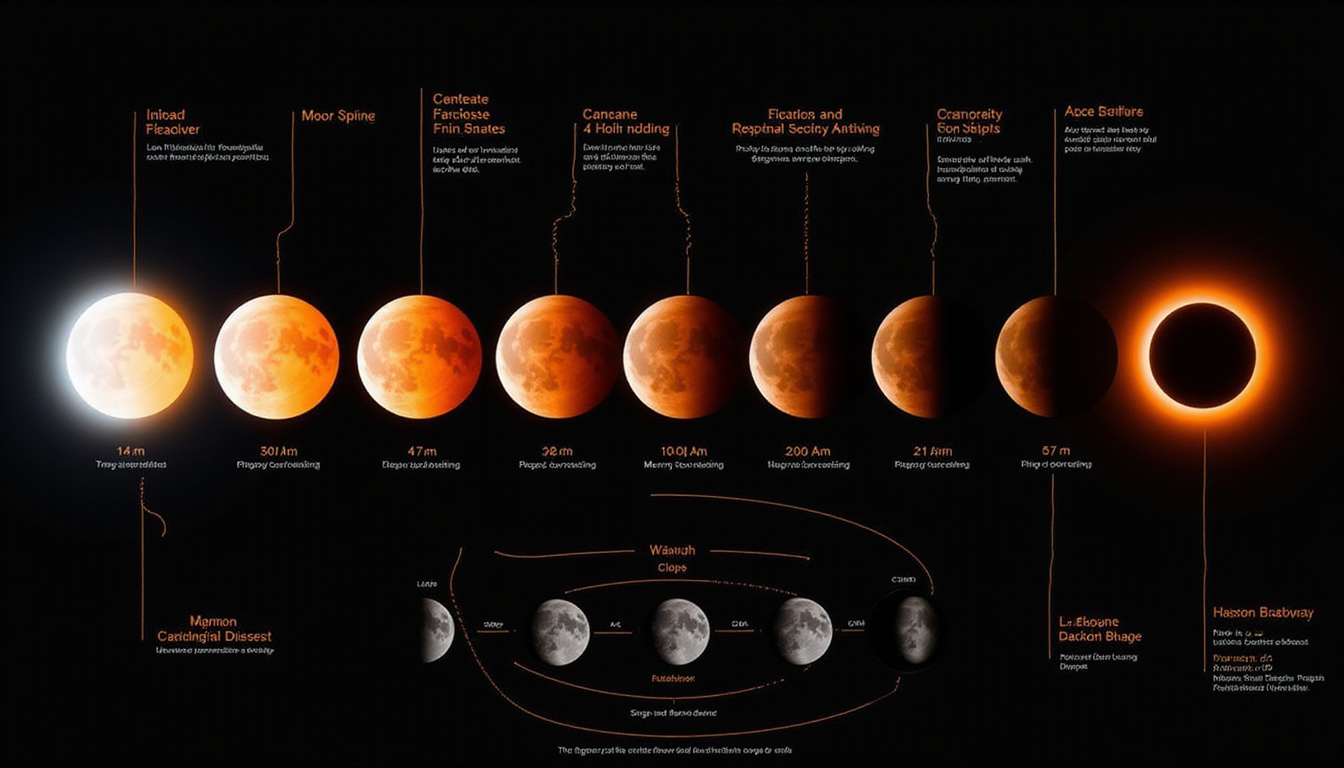
- Shoot a series of photos at intervals (e.g., every 10–15 minutes) and later combine them into a composite image that shows the entire progression.
The Science Behind a Lunar Eclipse
Understanding the mechanics of a lunar eclipse makes it even more fascinating.
Orbital Geometry
- The Moon orbits Earth at a slight tilt (~5°) relative to Earth’s orbit around the Sun.
- Because of this tilt, the full Moon usually passes above or below Earth’s shadow.
- A lunar eclipse occurs only when the Moon is full and near one of the two nodes—points where the Moon’s orbit crosses the Earth-Sun plane.
Why Eclipses Don’t Happen Every Full Moon
If all three bodies (Sun, Earth, Moon) were perfectly aligned in the same plane, we’d see a lunar and solar eclipse every month. The orbital tilt is what makes eclipses special and relatively rare from any one location.
Atmospheric Effects and Color
When the Moon is completely in Earth’s umbra, sunlight reaching it has:
- Passed through Earth’s atmosphere.
- Been refracted (bent) into the shadow.
- Been scattered so that shorter blue wavelengths are filtered out, while longer red/orange wavelengths dominate.
The exact color of a total lunar eclipse can be influenced by:
- Volcanic eruptions injecting dust and aerosols into the atmosphere.
- Global pollution levels.
- Cloud patterns along the line of sight of refracted sunlight.
Cultural and Historical Perspectives
Throughout history, lunar eclipses have captured human imagination:
- Ancient Mesopotamia and China: Eclipses were seen as omens; rulers employed astronomer-priests to predict them.
- Indigenous Traditions: Many cultures have rich stories, from celestial animals eating the Moon to spiritual battles in the sky.
- Scientific Milestones: Eclipses helped early astronomers understand the Earth-Moon-Sun geometry and confirm that Earth is spherical (the round shadow on the Moon is strong evidence).
Today, a lunar eclipse is more celebration than omen, inspiring star parties, public events at observatories, and global live streams.
Simple Checklist for Your Next Lunar Eclipse
Use this quick list to prepare:
- Look up:
- Date/time of the next lunar eclipse
- Visibility from your location
- Exact phases and local times
- Scout a viewing site:
- Low light pollution
- Clear horizon in the direction of the Moon
- Pack:
- Warm clothing and blanket or chair
- Binoculars or small telescope (optional)
- Camera or smartphone + tripod
- Snacks, drinks, red-light flashlight
- Plan shots (optional):
- Decide between close-ups or landscape compositions
- Test focus and exposure on a regular full Moon before eclipse night
FAQ About Lunar Eclipses
Q1: How often does a lunar eclipse happen?
Lunar eclipses occur at least two times per year somewhere on Earth, but any specific location may only see a lunar eclipse every few years, depending on the alignment of the Moon’s orbit and your position on the globe.
Q2: What’s the difference between a solar and a lunar eclipse?
A solar vs lunar eclipse comparison comes down to what’s being shadowed and by whom:
- In a solar eclipse, the Moon passes between Earth and the Sun, casting a shadow on Earth.
- In a lunar eclipse, Earth passes between the Sun and Moon, casting its shadow on the Moon.
Solar eclipses require eye protection; lunar eclipses do not.
Q3: Why do some people call it a Blood Moon lunar eclipse?
The term Blood Moon lunar eclipse refers to a total lunar eclipse when the Moon turns a deep reddish or copper color. This is caused by Earth’s atmosphere filtering and bending sunlight into its shadow, allowing red wavelengths to illuminate the Moon.
A lunar eclipse is one of the most accessible astronomical events you can experience—no special filters, no complicated safety gear, just a little planning and a willingness to step outside and look up. Start by checking when the next eclipse is visible from your area, gather a few essentials, and consider inviting friends or family to share the moment. Whether you simply watch the Moon turn red or challenge yourself to capture stunning eclipse photos, make the next lunar eclipse a night to remember.
Want to understand the deeper meaning behind spiritual practices and beliefs? Visit SpiritualMindScience.com for science-informed spiritual education.