From viral TikToks to heated Twitter threads, planetary alignments are suddenly everywhere. Some people blame them for mood swings, tech glitches, and even chaotic money decisions. Others brush it all off as superstition. The truth sits somewhere more nuanced—and more interesting—than either extreme. When you look at the history, the psychology, and even the physics, you find plenty of ways planetary alignments can shape how we feel, behave, and build our technologies, whether directly or indirectly.
This guide walks through what planetary alignments are, how they’re believed to influence mood and money, and where tech and space weather come crashing into the story.
What Are Planetary Alignments, Really?
Before we talk mood, money, and tech, it helps to define what “planetary alignments” actually means.
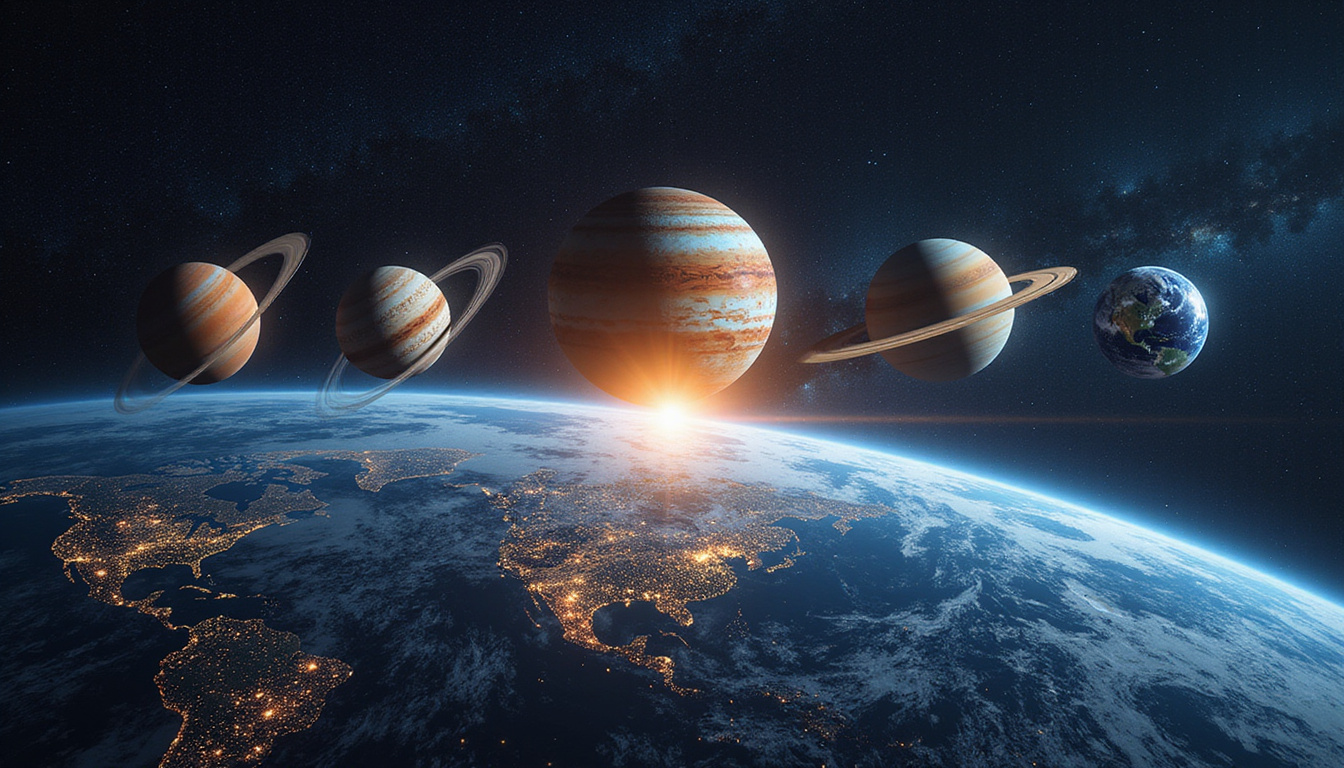
In astronomy, a true perfect line-up of planets is extremely rare. More commonly, you get:
- Conjunctions – when two (or more) planets appear near each other in our sky.
- Oppositions – a planet appears opposite the Sun from Earth’s perspective.
- Groupings or “syzygies” – multiple bodies lining up roughly along the same line with the Sun and Earth.
Astrology uses these patterns symbolically, interpreting alignments as energetic “weather” that corresponds with events on Earth. Astronomy, on the other hand, focuses on gravitational, electromagnetic, and orbital mechanics.
Most of the time, the gravitational effects of planetary alignments on Earth are tiny. But their perceived effects—and how humans respond to them—can be huge.
The Psychology Behind Planetary Alignments and Mood
Many people report feeling “off” when there’s a big planetary event: anxious, dreamy, exhausted, or creatively charged. Some of that can be explained without invoking cosmic forces at all.
Expectation Effects and Emotional Priming
When major planetary alignments hit the news, social feeds fill up with warnings:
- “Get ready, this alignment will shake up your emotions.”
- “You’ll feel tired and drained this week.”
- “Relationships will be tested.”
These messages act as emotional priming. Once you expect to feel strange, your brain:
- Notices and magnifies any mood changes.
- Ignores or downplays moments when you feel normal.
- Builds a narrative that matches what you were told.
This isn’t just anecdotal; research on the placebo and nocebo effect shows that expectations can strongly shape both physical and mental experience (source: NIH). Planetary alignments, for many people, function as a kind of psychological weather forecast.
Pattern-Seeking Brains
Humans are wired to see patterns. When:
- Something unusual happens (big fight, sudden job change, emotional crash)
- And it coincides with a well-publicized alignment
we naturally connect the dots. That doesn’t mean there’s no connection; it means we have to be careful about what kind of connection it is—symbolic, psychological, cultural, physical, or a mix.
Can Planetary Alignments Physically Affect Mood?
Is there any plausible physical pathway from planetary positions to human mood?
Gravitational Pull: Tiny but Real
Planets do exert a gravitational force on Earth, but it’s minuscule compared to:
- The Moon (which drives tides)
- The Sun (which shapes Earth’s orbit, light, and climate)
Even during dramatic planetary alignments, the added gravitational force on your body is far weaker than, say, the gravity of nearby buildings. That makes direct gravitational influence on mood unlikely from a pure physics standpoint.
Space Weather and the Earth’s Magnetic Field
Where things get more interesting is space weather:
- Solar flares
- Coronal mass ejections (CMEs)
- Changes in the solar wind and Earth’s magnetosphere
These can disturb geomagnetic activity, which some studies have tentatively linked to changes in human biology and mood, including:
- Sleep disruption
- Changes in heart rate variability
- Fluctuations in mood or cognition
These solar events aren’t caused by planetary alignments, but certain alignments can coincide with increased observation and monitoring of solar behavior. People may associate mood changes with the alignment, while the underlying driver is solar activity.
The takeaway: while planets themselves probably aren’t “zapping” your emotions, space weather and circadian disruption can influence mood—and cultural focus on alignments makes us more aware of those changes.
Money and Markets: Do Planetary Alignments Move Your Wallet?
Astrological finance—sometimes called financial astrology—has a long and controversial history. Traders and investors have tried to time markets based on the movement of planets for centuries.
How Financial Astrology Sees Alignments
Practitioners often claim that:
- Conjunctions of outer planets (like Saturn–Uranus) correlate with economic shocks.
- Alignments involving Venus or Jupiter relate to expansion, spending, or optimism.
- Eclipses and major syzygies can mark turning points in market cycles.
They’ll overlay planetary charts on stock market indices, commodity prices, or Bitcoin charts and look for recurring patterns.
What Mainstream Economics Says
From a scientific and economic standpoint:
- There’s no broadly accepted causal mechanism linking planetary alignment positions to market fundamentals.
- Markets are influenced by interest rates, earnings, policy, innovation, and human psychology—none of which need planetary explanations.
However, there is an intriguing nuance: belief itself has power.
The Self-Fulfilling Prophecy Angle
If a critical mass of traders or investors believe a certain alignment is “bad for markets,” they might:
- Sell early “just in case”
- Tighten risk management
- Delay big buys
This can actually move prices—in which case, the alignment didn’t directly cause the shift, but collective belief and behavior did.
In other words, planetary alignments may influence money indirectly, via:
- Trader psychology – fear, greed, risk appetite.
- Narratives – stories that spread through trading communities.
- Timing – when people choose to act, buy, or sell.
For your personal finances, the practical takeaway is simple: use cosmic events as prompts for reflection, not as the sole basis for money decisions.
Tech, Space Weather, and Alignment Chaos
Of all the claims about planetary alignments, the connection to technology and infrastructure has the strongest footing—though again, not quite in the way social media suggests.
Space Weather: The Real Tech Disruptor
The big player here isn’t Mars, Saturn, or Jupiter—it’s the Sun.
Solar storms can:
- Disrupt satellite communications and GPS
- Interfere with high-frequency radio
- Induce currents in power grids and pipelines
- Damage spacecraft electronics
These effects are well documented. The famous Carrington Event of 1859 caused telegraph systems to fail and sparks to fly from equipment. Modern equivalents can affect:
- Aviation and navigation
- Internet backbone connections using satellite links
- Precision timing systems used in finance and telecom
Where Planetary Alignments Come In
Planetary alignments can matter in a few indirect ways:
-
Orbital Dynamics and Probes
Space agencies use alignments to slingshot spacecraft more efficiently. When multiple alignments occur, we often see more deep-space missions, more data collection, and more public awareness of space hazards. -
Observation Windows
Certain planetary alignments make it easier to observe solar and planetary behavior from particular vantage points, increasing our ability to detect and predict space weather impacts. -
Global Synchronization
As more systems—financial markets, power grids, and communication networks—sync up worldwide, any large-scale disturbance (including one related to space weather) can cascade quickly. If that disturbance happens near a major alignment, people may tie the two together.
The shock value isn’t that alignments magically fry your phone. It’s that space weather can absolutely disrupt tech, and our interconnected systems are more vulnerable than most people realize.
How to Use Planetary Alignments in a Grounded, Practical Way
You don’t need to accept or reject astrology wholesale to find value in planetary alignments. You can treat them as:
- Psychological anchors – times to self-reflect and reset.
- Cultural markers – shared moments of emotional focus.
- Space weather reminders – prompts to check solar and geomagnetic activity.
Here are practical ways to engage:
-
Mood Tracking
Keep a simple log of:- Sleep quality
- Mood
- Productivity
Then note major planetary events or high solar-activity days. After a few months, see if you notice any pattern—personal data beats generic predictions.
-
Money Mindfulness
When big alignment hype hits:- Review your budget and goals.
- Notice whether fear or FOMO is driving your financial decisions.
- Commit to decisions that still make sense without the cosmic story.
-
Tech Resilience
For individuals and businesses:- Back up critical data regularly.
- Understand your reliance on GPS and cloud services.
- Stay informed about space weather alerts from agencies like NOAA’s Space Weather Prediction Center.
Common Myths About Planetary Alignments
Planetary alignments attract a lot of misinformation. A few widespread myths include:
-
“Alignments massively increase gravity and cause disasters.”
In reality, the incremental gravitational effect is tiny; earthquakes, tides, and storms are driven mainly by Earth, the Sun, and the Moon. -
“Planets perfectly line up like beads on a string.”
Most alignments are approximate, from Earth’s viewpoint. In 3D space, the planets are spread out over vast distances. -
“All tech outages during alignments are cosmic in origin.”
Most tech issues are mundane: software bugs, human error, hardware failures. Space weather is real, but it’s one factor among many.
Understanding these helps you keep a clear head while still appreciating the symbolic and psychological power that alignments hold.
FAQ: Planetary Alignments and Their Surprising Impacts
Q1: Do planetary alignments affect human behavior?
Planetary alignments can influence human behavior indirectly through psychology, culture, and expectation. When people anticipate upheaval, they may act differently—changing relationships, money choices, or risk-taking. Direct physical effects on behavior from planetary gravity are extremely unlikely.
Q2: Can planetary alignments affect technology or the internet?
Alignments themselves don’t typically damage tech, but space weather—especially solar storms—does. Because public focus on the sky increases around planetary alignments, people often connect tech glitches to them. In reality, it’s the Sun’s activity, not the planets’ positions, that poses the major risk to satellites, GPS, and power grids.
Q3: Are there real-world benefits to tracking planetary alignments?
Yes, if you use them wisely. Tracking planetary alignments can help you build:
- Regular checkpoints for self-reflection and goal-setting
- Awareness of space weather risks for tech and infrastructure
- A structured way to explore how your mood, sleep, and decisions change over time
It becomes a useful framework when combined with critical thinking and data, not a substitute for it.
Final Thoughts: Turn Planetary Alignments into a Tool, Not a Fear
Planetary alignments don’t have to be scary omens or empty superstition. They can be powerful mental and cultural markers—moments when you pause, pay attention, and realign your inner world and outer life.
If you’re curious how these alignments might be shaping your mood, decisions, and digital world, don’t just scroll past the next “massive cosmic event” headline. Use it:
- As a signal to check in with your emotional state.
- As a prompt to review your budget and long-term goals.
- As a reminder to safeguard your tech and data in an increasingly space-dependent world.
Start a simple journal or tracking system around upcoming planetary alignments and space weather alerts, and see what patterns actually show up in your life. By blending cosmic curiosity with grounded skepticism, you turn planetary alignments from vague anxiety fuel into a practical, empowering tool for navigating mood, money, and technology.
Learn how astronomy, psychology, and spiritual traditions intersect by visiting SpiritualMindScience.com for deeper insights.