Planetary dynamics is at the heart of understanding how worlds form, evolve, and ultimately become capable of supporting life. From the way planets orbit their stars to the subtle gravitational tugs between neighboring worlds, planetary dynamics weaves together the hidden forces that sculpt habitable environments. By studying these intricate motions and interactions, scientists can identify which distant exoplanets might be stable, life-friendly havens—and which are cosmic train wrecks in slow motion.
What is planetary dynamics?
Planetary dynamics is the study of how planets, moons, asteroids, and other bodies move and interact under the influence of gravity and related forces. It combines celestial mechanics, orbital physics, and long-term stability analysis to answer questions like:
- How do planetary systems form from disks of gas and dust?
- Why do some worlds have circular orbits while others are elongated or chaotic?
- What conditions keep a planet’s climate stable enough for liquid water?
In essence, planetary dynamics turns the night sky into a physical lab. By applying Newton’s laws, general relativity, and modern computational tools, astronomers can simulate billions of years of motion in a supercomputer, revealing how small nudges and resonances ripple through entire planetary systems.
The building blocks: orbits, gravity, and resonances
To understand how planetary systems develop habitable worlds, it helps to start with three foundational concepts of planetary dynamics: orbital properties, gravitational interactions, and orbital resonances.
Orbital shape and distance
A planet’s orbit is defined by several key parameters, especially:
- Semi-major axis: the average distance from the star.
- Eccentricity: how stretched out (elliptical) the orbit is.
- Inclination: the tilt of the orbit relative to some reference plane.
These properties powerfully influence climate:
- Distance sets the overall amount of stellar energy the planet receives.
- Eccentricity determines how much that energy fluctuates over one orbit.
- Inclination and axial tilt (which is related but distinct) affect seasons and climate patterns.
Worlds with moderately circular orbits in the so‑called habitable zone—the range of distances where liquid water can exist on the surface—are prime candidates for life as we know it.
Gravitational nudges between neighbors
No planet exists in isolation. Neighboring planets constantly tug on each other, exchanging angular momentum and slightly shifting orbits over time. When these gravitational interactions line up in regular patterns, they can become especially powerful.
Orbital resonances: cosmic rhythms
An orbital resonance occurs when two bodies’ orbital periods have a simple ratio—for example, 2:1 or 3:2. In such cases, gravitational pulls reinforce each other at regular intervals.
Resonances can:
- Stabilize orbits (as with Jupiter’s moons Io, Europa, and Ganymede in a 4:2:1 resonance).
- Destabilize regions, clearing out debris (like the Kirkwood gaps in the asteroid belt caused by Jupiter).
For potentially habitable planets, the right resonances can keep orbits predictably stable. The wrong ones can drive eccentricity higher, leading to extreme climate swings or even orbital crossings and collisions.
From dust to diverse worlds: dynamics in planet formation
Planetary dynamics begins shaping habitability long before a planet is fully formed. In the early stages of a planetary system:
- A protoplanetary disk of gas and dust surrounds a young star.
- Tiny grains collide and stick, forming kilometer-sized planetesimals.
- These grow via collisions and accretion into Moon- and Mars-sized planetary embryos.
- Embryos interact gravitationally, merging or scattering as they clear their orbits.
Each step is governed by dynamics: how bodies move, collide, and exchange energy.
The role of planetary migration
One of the most dramatic outcomes of planetary dynamics in young systems is planetary migration. Giant planets, interacting with the surrounding gas disk, can spiral inward or outward from where they originally formed.
This migration can:
- Resculpt inner systems, ejecting or swallowing early rocky planets.
- Deliver volatile-rich material (like water-bearing asteroids) to inner zones.
- Set the architecture of the final system—whether it has hot Jupiters close-in, compact super-Earths, or widely spaced giants like our own.
Our solar system itself likely experienced a phase of migration and resonant reconfiguration (the “Nice model”), which may have influenced the delivery of water and heavy elements to Earth and shaped the asteroid belt (source: NASA Exoplanet Exploration).
How planetary dynamics shapes habitability
The question of whether a world can be habitable goes far beyond “Is it in the right place?” Planetary dynamics affects not just where a planet is, but how stable, temperate, and geologically active it remains over billions of years.
Orbital stability and climate
A habitable planet needs reasonably stable conditions over long timescales. Key factors include:
- Long-term orbital stability: If a planet’s orbit becomes chaotic or crosses others, it risks catastrophic collisions or ejection from the system.
- Moderate eccentricity: Highly elongated orbits create extreme temperature swings, potentially pushing climates into snowball or runaway greenhouse states.
- Secular variations: Slow, predictable changes in eccentricity and tilt (like Earth’s Milankovitch cycles) can drive natural climate cycles but still allow overall habitability.
In the best scenarios, planetary dynamics maintains a “climate sweet spot”: enough variation to stimulate evolution and ecosystem diversity, but not so much that oceans repeatedly boil or freeze solid.
Giant planets as guardians (and threats)
Large planets can act as both protectors and disruptors:
- Shielding: A giant planet like Jupiter can scatter or capture comets and asteroids that might otherwise bombard inner habitable planets.
- Perturbing: If a giant’s orbit is eccentric or too close to the habitable zone, its gravity can destabilize terrestrial planet orbits or cause severe eccentricity pumping.
Whether giant planets help or hurt habitability depends on their mass, position, and orbital shape. Planetary dynamics simulations are crucial to untangling these trade-offs in exoplanetary systems.
Tidal forces and internal heat
Another subtle but powerful aspect of planetary dynamics is tidal interaction. Gravitational tides between a planet, its moon, and its star:
- Dissipate energy as heat in the planet’s interior.
- Can drive volcanism and tectonics, renewing surfaces and recycling nutrients.
- Affect rotation rate and axial tilt, often leading to tidal locking around low-mass stars.
For habitability, tidal heating is a double-edged sword:
- Moderate tidal heating can keep subsurface oceans liquid (like on Europa or Enceladus) and maintain geologic activity on small worlds.
- Excessive tidal heating can turn a planet into a volcanic hellscape, as seen on Jupiter’s moon Io.
In tightly packed systems around red dwarf stars, planetary dynamics and tidal forces together may determine whether a world has a benign surface ocean or a runaway greenhouse.
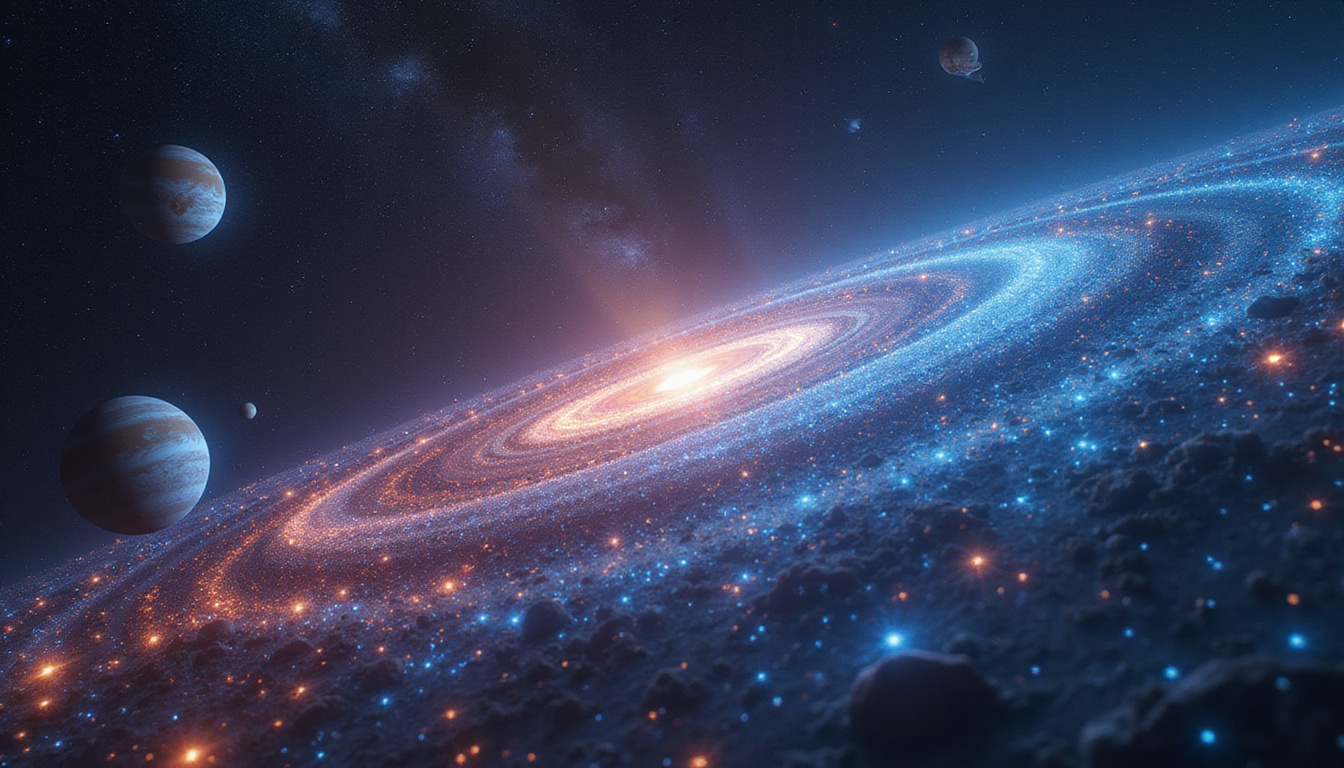
Planetary dynamics and the habitable zone
The classical habitable zone (HZ) is defined by the range of distances where a planet with Earth-like atmosphere and pressure could sustain liquid water on its surface. But planetary dynamics complicates this picture in several ways.
The concept of a “dynamically habitable zone”
A more realistic view combines climate science with orbital stability:
- The climatic HZ: where stellar flux allows liquid water.
- The dynamical HZ: where orbits remain stable and not excessively eccentric over billions of years.
A planet might sit at a perfect distance for temperate conditions, yet be dynamically uninhabitable because:
- Nearby massive planets constantly pump its eccentricity.
- Resonances drive large, chaotic orbital variations.
- Long-term interactions lead to eventual ejection or collision.
When astronomers evaluate exoplanets in the habitable zone, planetary dynamics analysis is essential to determine if those worlds can actually maintain that position and climate for geologically meaningful times.
Multi-planet systems and compact architectures
Many exoplanetary systems discovered by missions like Kepler are compact, with several planets packed closer to their star than Mercury is to the Sun. In these systems:
- Planets are often near mean-motion resonances.
- Even small mass differences can have large dynamical implications.
- Stability may hinge on precise orbital configurations.
For potentially habitable worlds in such systems, scientists run large ensembles of N‑body simulations to see which architectures remain stable. Survivors in these simulations are prime targets for future atmospheric characterization.
Observing planetary dynamics in exoplanetary systems
Planetary dynamics isn’t just theoretical. Astronomers directly observe its signatures and use them to infer unseen planets, orbital interactions, and long-term stability.
Transit timing variations (TTVs)
When a planet passes in front of its star (a transit), we can precisely measure the timing of each event. If multiple planets are present, their mutual gravity causes:
- Early or late transits compared to a perfectly periodic schedule.
- Patterns in timing that reveal planet masses and resonances.
These transit timing variations are a powerful tool to probe planetary dynamics and discover non-transiting planets in a system.
Radial velocity and orbital evolution
The radial velocity method measures the star’s wobble due to orbiting planets. Over time, changes in that wobble can hint at:
- Planet-planet interactions.
- Secular evolution in eccentricity and inclination.
- Potential instability, especially in tightly packed systems.
With long baselines of data, astronomers can test dynamical models and refine our understanding of system architecture.
Key dynamical factors that favor habitable worlds
While every planetary system is unique, planetary dynamics research highlights several patterns that tend to favor habitable outcomes:
- Moderately spaced terrestrial planets: enough separation to reduce strong, destabilizing interactions.
- Giant planets in wide, near-circular orbits: offering some shielding without excessive perturbation.
- Limited extreme resonances in the HZ: avoiding large, chaotic eccentricity variations.
- Manageable tidal effects: enough to maintain geologic activity, not so much as to cause runaway heating.
- Long-term orbital stability: minimal risk of collisions or ejections over billions of years.
These factors help guide target selection for upcoming observatories searching for biosignatures in exoplanet atmospheres.
FAQ: planetary dynamics and habitable worlds
1. How does planetary dynamics affect whether a planet is habitable?
Planetary dynamics determines if a planet’s orbit in the habitable zone is stable and moderate over long periods. Strong gravitational interactions, resonances, or nearby giant planets can increase orbital eccentricity, leading to extreme climate swings or destabilization. A dynamically calm environment supports long-term liquid water and stable climates, key ingredients for habitability.
2. Why are orbital resonances important in planetary system dynamics?
In planetary system dynamics, orbital resonances can lock planets into regular gravitational rhythms. These can either stabilize system architecture—maintaining predictable orbits—or destabilize regions by amplifying eccentricities and inclinations. Understanding resonances helps astronomers assess which exoplanet systems are dynamically stable enough to host habitable planets.
3. Can planetary dynamics make a planet outside the classical habitable zone livable?
Yes. Through planetary dynamics, tidal heating and orbital interactions can maintain subsurface oceans on icy moons or planets beyond the classical habitable zone. For example, strong tidal forces can keep water liquid under ice shells even far from the star. While such environments are different from Earth’s surface habitability, they may still offer niches where life could arise and persist.
Bringing it all together: why planetary dynamics matters now
As the search for life beyond Earth accelerates, planetary dynamics is emerging as a crucial filter for prioritizing targets. A planet’s mere presence in the habitable zone is no longer enough; scientists must understand the full dynamical story of its system—how planets interact, how stable orbits remain, and whether hidden forces promote or undermine habitability.
Upcoming telescopes and missions will provide unprecedented data on exoplanet atmospheres and climates. To interpret that data correctly, we need robust planetary dynamics models that reveal which worlds are likely to be long-lived, stable, and truly habitable.
If you’re exploring exoplanet data, designing observation campaigns, or communicating about worlds beyond our solar system, make planetary dynamics a central part of your toolkit. Delve into the orbital architectures, run or consult dynamical simulations, and use these insights to focus on the most promising habitable worlds—and to better understand the hidden forces that made Earth possible in the first place.
Learn how astronomy, psychology, and spiritual traditions intersect by visiting SpiritualMindScience.com for deeper insights.