Planetary Elongation Guide: Spot and Time Rare Sky Pairings
Understanding planetary elongation is one of the most practical skills you can develop as a skywatcher. Whether you’re a casual stargazer, an astrophotographer, or just someone who loves rare cosmic alignments, elongation tells you when and where to look to catch planets and striking pairings in the sky.
In this guide, you’ll learn exactly what planetary elongation is, why it matters, how to use it to time close approaches and conjunctions, and how to plan unforgettable observations of rare sky pairings.
What Is Planetary Elongation?
In simple terms, planetary elongation is the angular distance between a planet and the Sun in our sky, measured along the ecliptic (the apparent path of the Sun). Imagine drawing a line from the Sun to Earth, and another line from Earth to the planet. The angle between those two lines is the elongation.
- When a planet is close to the Sun in the sky, its elongation is small.
- When it’s far from the Sun in the sky, its elongation is large.
Elongation is measured in degrees (°). At 0°, the planet is visually “with” the Sun. At higher values—20°, 40°, 90°—the planet is spread out along the sky, farther from the Sun’s glare and easier to spot.
Inner vs. Outer Planets: Why Elongation Works Differently
How planetary elongation behaves depends on whether a planet’s orbit is inside or outside Earth’s orbit.
Inner Planets (Mercury and Venus)
Mercury and Venus are called inferior planets because they orbit closer to the Sun than Earth. They never stray far from the Sun in the sky.
Key elongation behaviors:
-
Mercury:
- Maximum elongation: typically ~18°–28°
- Visible low in the east before sunrise or in the west after sunset
- Often challenging to see because it stays near bright twilight
-
Venus:
- Maximum elongation: up to ~47°
- Can be very bright, famously called the “Morning Star” or “Evening Star”
- Much easier to observe than Mercury
For inner planets, you’ll see two special elongation events:
- Greatest Eastern Elongation – Planet is east of the Sun and visible after sunset (an evening object).
- Greatest Western Elongation – Planet is west of the Sun and visible before sunrise (a morning object).
These are the best times to see Mercury and Venus, as they’re highest and farthest from the Sun’s glare.
Outer Planets (Mars, Jupiter, Saturn, and beyond)
Outer, or superior, planets orbit farther from the Sun than Earth. They can appear anywhere along the ecliptic, not just close to the Sun.
For these, elongation can reach up to 180°:
- Conjunction (elongation ≈ 0°): Planet appears close to the Sun in the sky and is usually not visible.
- Opposition (elongation ≈ 180°): Planet is opposite the Sun; it rises at sunset, is highest at midnight, and sets at sunrise—this is generally the best time to observe it.
Outer planet elongations are crucial for planning deep, dark-sky observations and photographing planets at their brightest.
Why Planetary Elongation Matters for Sky Pairings
Rare alignments and close pairings depend heavily on planetary elongation. When the elongations of two or more bodies line up relative to the Sun and Earth, you can get:
- Conjunctions: Two planets, or a planet and the Moon, appear close together on the sky.
- Appulses: Even closer apparent approaches in the sky, sometimes even closer than a simple conjunction.
- Double or multiple planet groupings: For example, Venus, Jupiter, and the Moon all gathering in a small patch of sky.
Understanding elongation helps you:
- Predict visibility windows – Know if a pairing will happen at dawn, dusk, or deep night.
- Assess difficulty – Small elongation means objects are near the Sun and harder to see; larger elongation usually means easier viewing.
- Plan photos – You can frame the pair with foreground objects (mountains, buildings, trees) at the right time.
Greatest Elongation: The Sweet Spot for Inner Planet Pairings
When Mercury or Venus reach their greatest elongation, they’re farthest from the Sun in the sky and at their highest above the horizon in twilight.
This is prime time for eye-catching pairings such as:
- Venus close to a thin crescent Moon at dusk.
- Mercury pairing with Venus in deep twilight.
- Mercury lining up with a bright star like Spica or Regulus.
Because inner planets are often washed out by sunlight, pairing events near greatest elongation are significantly easier to observe.
Eastern vs. Western Elongation
-
Greatest Eastern Elongation:
- Planet appears in the evening sky.
- Best for after-work observations and public star parties.
-
Greatest Western Elongation:
- Planet appears in the morning sky.
- Best for early risers and photographers chasing colorful dawn skies.
For very tight sky pairings involving Mercury, target dates when the other object (Moon, Venus, or a bright star) is also near that planet’s greatest elongation.
Opposition, Conjunction, and Elongation of Outer Planets
Outer planets don’t have “greatest elongation” in the same sense as Mercury and Venus. Instead, we focus on:
- Conjunction (elongation ≈ 0°): Planet is on the far side of the Sun. Almost always lost in solar glare.
- Quadrature (elongation ≈ 90°): Planet forms a right angle with the Sun and Earth. It’s visible during part of the night and can show interesting shadow effects (notably on Jupiter’s moons).
- Opposition (elongation ≈ 180°): Planet is at its brightest and largest in a telescope. Best time for high-quality observations and astrophotography.
Pairings often cluster around quadrature or a few weeks before/after opposition, when planets and the Moon share night sky hours and can be framed together against the Milky Way or constellations.
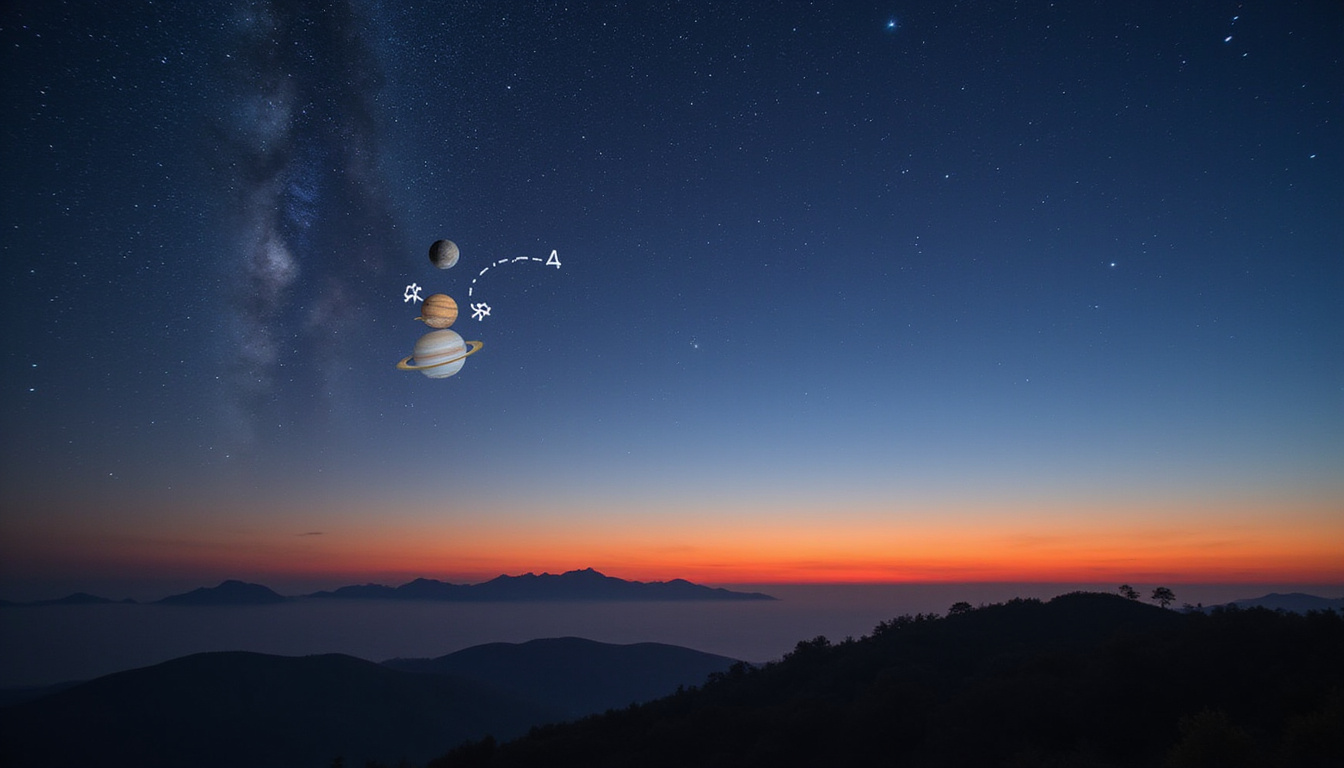
How to Read Elongation Values in Astronomy Apps
Most modern tools give you planetary elongation directly:
- Planetarium software (e.g., Stellarium)
- Astronomy planner apps (e.g., SkySafari, Star Walk, or similar)
- Online ephemeris services (e.g., JPL Horizons, or charts from observatories and NASA)
When using these tools, note:
-
Inner planets:
- Scan for “Greatest Eastern Elongation” or “Greatest Western Elongation.”
- Check the elongation in degrees; the larger the value (within each planet’s limit), the better.
-
Outer planets:
- Look for “Elongation from Sun” or separate listings of “Conjunction,” “Opposition,” and “Quadrature.”
- Larger elongation values (approaching 180°) mean longer, darker observing windows.
If your tool doesn’t list elongation directly, you can estimate it by:
- Looking at the projected paths of the Sun and the planet along the ecliptic.
- Using the right ascension (RA) difference as an approximation: each hour of RA ≈ 15° along the ecliptic.
Planning Rare Sky Pairings with Planetary Elongation
To time rare pairings, use planetary elongation as a planning backbone. Here’s a simple workflow:
-
Identify the planets you care about
Common favorites: Venus–Jupiter pairings, Mars–Jupiter, Saturn–the Moon, or Mercury–Venus near elongation. -
Check when each planet is visible
- Inner planets: around their greatest elongation dates.
- Outer planets: near opposition or during favorable seasons for your hemisphere.
-
Consult a yearly sky calendar
- Use resources from observatories or organizations like Sky & Telescope or NASA, which publish dates for conjunctions and elongations (source: NASA Skywatching).
-
Look for overlaps
- Note when the Moon will pass each planet.
- Check when two planets come within a few degrees (or less) of each other while both have reasonable elongation from the Sun.
-
Refine with an app
- Move day-by-day around those dates and watch the sky map.
- Note the exact local time when the paired objects are highest and the sky is dark enough.
Practical Tips for Observing Pairings at Different Elongations
At Small Elongations (Near the Sun)
- Expect bright twilight or even daylight; safety first—never sweep near the Sun with optical aids.
- Use buildings, hills, or trees to safely block the Sun below the horizon while you search just above it.
- Focus on very bright targets like Venus or the Moon–Venus pairings.
At Moderate Elongations (20°–60°)
- Perfect for twilight compositions with foreground scenery.
- Mercury and Venus become much more accessible.
- Great for wide-field photography using short focal lengths (14–50 mm).
At Large Elongations (60°–180°)
- Outer planets are prominent in darker skies.
- Multiple planets may be spaced along the ecliptic, enabling panoramic shots.
- Moon–planet pairings at these elongations can be both bright and easy to observe.
Simple Checklist: Using Elongation to Plan Your Observing Night
Use this quick list to organize your next outing around planetary elongation:
- Check current elongations for Mercury, Venus, and the outer planets.
- Note any upcoming:
- Greatest elongations (inner planets)
- Conjunctions, oppositions, or quadratures (outer planets)
- Look for dates when:
- A planet is near greatest elongation, and
- The Moon or another planet is within a few degrees.
- Mark the time when:
- The Sun is 6–18° below the horizon (civil/nautical/astronomical twilight).
- Your target pairing is above local obstacles and reasonably high (>10–15° altitude).
- Scout a viewing site with:
- A clear horizon in the needed direction (east for morning, west for evening).
- Minimal light pollution, if possible.
- On the day:
- Check weather and cloud forecasts.
- Arrive early to set up and let your eyes adapt.
Common Mistakes When Using Planetary Elongation
- Ignoring horizon obstacles: A favorable elongation doesn’t guarantee the planet will clear your local trees, buildings, or hills in time.
- Confusing brightness with visibility: Mercury at a decent elongation can still be difficult if the sky is very bright; Venus, by contrast, can be striking even at smaller elongations.
- Not accounting for latitude: At higher latitudes, the ecliptic can hit the horizon at a shallow angle, making inner planets hug the horizon longer.
- Assuming any conjunction is easily visible: A conjunction exactly at small elongation might occur in broad daylight or deep in twilight.
Always cross-check elongation with altitude, time, and your local conditions.
FAQ: Planetary Elongation and Sky Pairings
What is greatest planetary elongation, and why is it important?
Greatest planetary elongation is when an inner planet (Mercury or Venus) reaches its maximum angular distance from the Sun in our sky. It’s important because it marks the best times to see these planets, especially Mercury, which is often hidden in twilight glare. Pairings with the Moon or other planets near greatest elongation are usually easier and more dramatic to observe.
How does planetary elongation affect planet visibility throughout the year?
Throughout the year, planetary elongation changes as planets move along their orbits. When elongation is low, a planet is close to the Sun in the sky and typically hidden in glare. As elongation grows, the planet moves into the evening or morning sky, becoming more accessible. For outer planets, visibility peaks near opposition when elongation is close to 180°, giving the longest and darkest viewing window.
How can I find planetary elongation and plan rare pairings?
You can find planetary elongation values through astronomy apps, planetarium software, or online ephemeris tables. Look for listings of elongation, greatest elongation, conjunctions, and oppositions. Then cross-reference those dates with Moon phases and planetary conjunctions to pinpoint nights when planets and the Moon cluster together. This approach lets you time rare sky pairings months in advance.
Turn Planetary Elongation into Your Personal Sky Calendar
Once you start using planetary elongation as your guide, the night sky stops being random and becomes a predictable, exciting calendar of events. You’ll know exactly when Mercury pops into view, when Venus dominates twilight, and when outer planets are at their best—and you’ll be ready for those rare moments when two or more celestial worlds share the same patch of sky.
Don’t let the next great pairing pass unnoticed. Open your favorite astronomy app or calendar today, check the upcoming elongations, and mark a few promising dates. With a bit of planning, some patience, and your new understanding of planetary elongation, you’ll be perfectly positioned to spot and time those rare sky pairings that most people never even know they missed.
Learn how astronomy, psychology, and spiritual traditions intersect by visiting SpiritualMindScience.com for deeper insights.