Planetary perturbations are the subtle gravitational “tugs” that planets and other bodies exert on one another, slowly modifying their orbits over time. At first glance, the solar system seems like a clockwork machine of planets tracing perfect ellipses. In reality, every orbit is being constantly adjusted by these tiny nudges. Over years, centuries, and billions of years, planetary perturbations can reshape orbital stability, triggering everything from gentle oscillations in a planet’s distance from the Sun to dramatic shifts that can eject worlds from their systems.
This article explains what planetary perturbations are, how they work, and why they matter for the past, present, and future of planetary systems.
From Perfect Ellipses to Real Orbits
In a simplified universe with only a star and one planet, orbital motion is clean and predictable: the planet follows a stable ellipse described by Kepler’s laws and Newton’s law of gravitation. But the real universe is a “many-body” problem, with multiple planets, moons, asteroids, and sometimes companion stars.
Each additional body introduces its own gravitational influence. On their own, these influences are tiny, but they accumulate:
- A giant planet like Jupiter slightly alters the path of every smaller body around the Sun.
- Moons can subtly shift the spin and orbit of their host planets.
- Passing stars or distant companion stars can distort the outer reaches of a planetary system.
These cumulative influences are what astronomers refer to as planetary perturbations—deviations from idealized orbits caused by other masses in the system.
The Physics Behind Planetary Perturbations
Gravitational Tugs and the N-Body Problem
The core of planetary perturbations is Newton’s law of universal gravitation: every mass attracts every other mass. For two bodies, we have exact mathematical solutions (the two-body problem). Add a third body, and the problem becomes analytically unsolvable in closed form—the infamous three-body problem.
Instead, astronomers use approximations and numerical simulations to track how orbits change. Each gravitational tug may be small, but their combined effect leads to:
- Slight changes in orbital eccentricity (how stretched the orbit is)
- Variations in inclination (tilt of the orbital plane)
- Shifts in semi-major axis (average orbital distance from the star)
- Precession of perihelion (slow rotation of the orbit’s orientation)
Over long timescales, these changes can be significant, especially in tightly packed planetary systems.
Secular vs. Short-Period Perturbations
Not all perturbations are alike. Astronomers classify them into:
-
Short-period perturbations
These are variations that occur over the course of one orbit or a few orbits. For example, a planet’s distance from the Sun might oscillate slightly over one year due to the influence of another planet. -
Secular perturbations
These are gradual, long-term drifts in orbital elements that accumulate over thousands to millions of years. Secular perturbations can lead to steady changes in eccentricity or inclination, reshaping the layout of a planetary system over geological timescales.
Both kinds are manifestations of planetary perturbations, but secular effects are especially important when discussing long-term orbital stability.
Resonances: When Tiny Nudges Add Up
Resonances are one of the most powerful ways planetary perturbations influence orbital stability. A resonance happens when two orbiting bodies have orbital periods in a simple ratio (like 2:1 or 3:2). Each time they align, they exchange energy in a consistent, repetitive way.
Mean-Motion Resonances
In mean-motion resonances, orbital periods line up as small integer ratios. Examples include:
- Neptune and Pluto in a 3:2 resonance: Pluto orbits the Sun twice for every three orbits of Neptune.
- Many asteroids in the main belt fall into resonances with Jupiter, producing gaps in the belt known as Kirkwood gaps.
In these cases, planetary perturbations become highly structured. Instead of random tiny pushes, the gravitational tugs repeat in sync, amplifying or damping orbital changes over time.
Secular Resonances
Secular resonances involve synchronization of slow processes, like the precession (gradual rotation) of orbits rather than orbital periods themselves. When a smaller body’s precession frequency matches that of a planet, energy can be efficiently transferred, driving long-term changes in eccentricity or inclination.
Resonances are a double-edged sword:
- They can stabilize orbits (as with Pluto’s safe dance with Neptune).
- They can destabilize regions, clearing out material, as Jupiter does in the asteroid belt.
How Planetary Perturbations Affect the Solar System
The Subtle Influence of Jupiter
Jupiter is the dominant source of planetary perturbations in our solar system, aside from the Sun itself. Its enormous mass allows it to:
- Shape the asteroid belt: Jupiter’s resonances carve gaps and redirect asteroids onto new paths.
- Affect Mars and the inner planets: Over millions of years, Jupiter’s tug contributes to variations in the eccentricities and inclinations of their orbits.
- Control many comet trajectories: Long-period comets that enter the inner solar system can have their orbits drastically altered by close encounters with Jupiter.
Without Jupiter’s perturbations, the inner solar system might have a different mix of small bodies—and possibly a different impact history.
Long-Term Stability of the Planets
Is the solar system stable over billions of years? Simulations suggest that while it is largely stable, planetary perturbations can introduce a small chance of dramatic events over very long timescales.
Studies of solar system dynamics have shown:
- The orbits of the inner planets are chaotic in a mathematical sense over hundreds of millions of years.
- Mercury’s orbit, in particular, is sensitive to the perturbations from Jupiter and other planets.
- There is a small but non-zero probability that Mercury could be destabilized, potentially colliding with Venus or the Sun over timescales of billions of years (source: Laskar, Nature 2008).
These are extreme scenarios, but they arise directly from the long-term accumulation of planetary perturbations in a chaotic system.
Milankovitch Cycles and Earth’s Climate
Planetary perturbations don’t just move planets; they also influence climate. On Earth, slow variations in:
- Orbital eccentricity
- Axial tilt (obliquity)
- Precession (wobble of Earth’s spin axis)
are driven in part by gravitational interactions with other planets, especially Jupiter and Saturn. These are known as Milankovitch cycles, and they:
- Modulate how sunlight is distributed across Earth’s surface
- Help pace the timing of ice ages and interglacial periods
In this way, planetary perturbations have indirectly shaped Earth’s geological and biological history.
Planetary Perturbations in Exoplanet Systems
Packed Planetary Systems and Instability
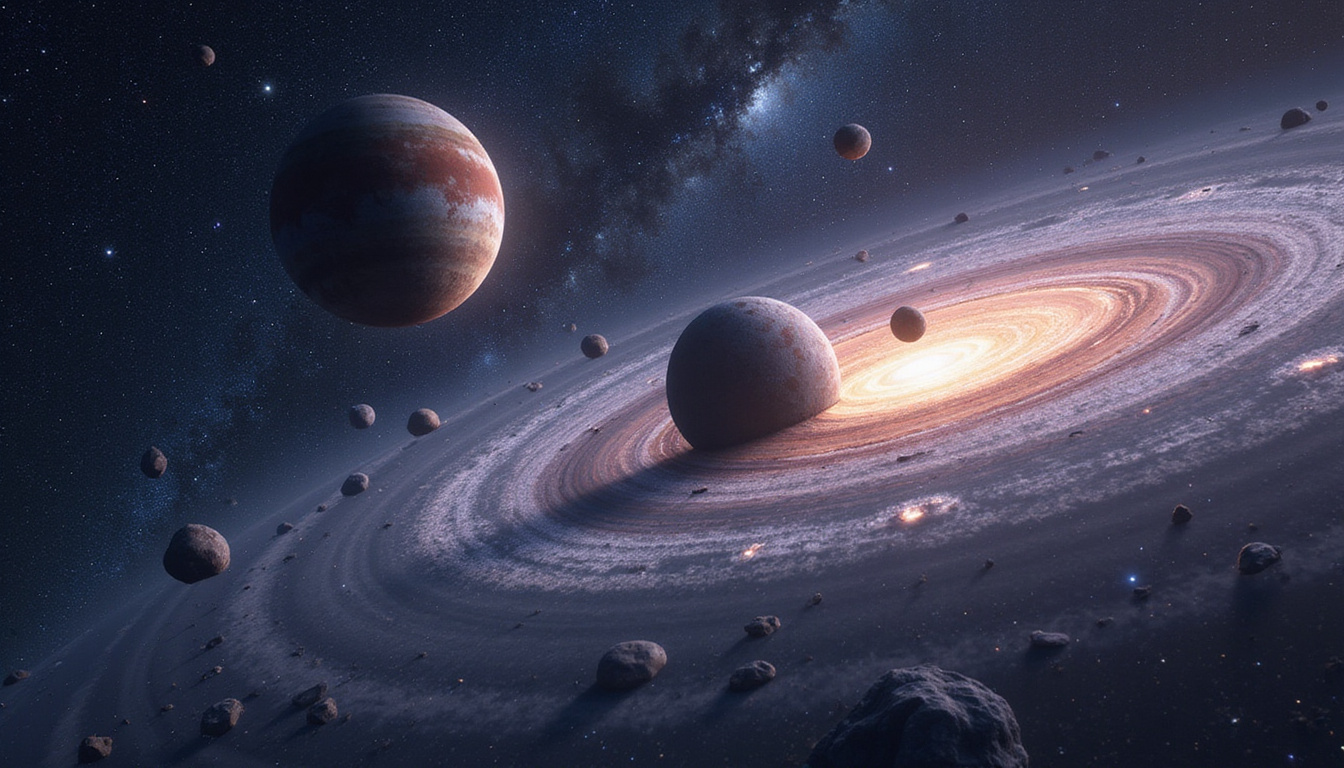
Many exoplanetary systems discovered by missions like Kepler and TESS are much more compact than our solar system. Multiple planets may orbit closer to their star than Mercury does to the Sun. In such tight configurations:
- Planetary perturbations are stronger because planets are closer together.
- The system can be near the edge of stability, where small changes can push orbits into crossing paths.
Numerical simulations show that many exoplanet systems can become unstable after hundreds of millions or billions of years, with planets scattering, colliding, or being ejected into interstellar space.
Resonant Chains and Migration
Some exoplanet systems exhibit resonant chains: multiple planets locked in sequential resonances (e.g., 4:3, 3:2, 2:1). This pattern suggests that planets migrated through the protoplanetary disk, with gas-driven motion outward or inward, and resonant planetary perturbations locking them into synchronized orbits.
Over time, disk dispersal and ongoing perturbations can break resonances, sometimes leading to rearrangements and instabilities.
Perturbations from Beyond: Stars and Galactic Effects
Planetary perturbations are not only about planet-planet interactions. External influences can also reshape orbital stability, especially in the outer regions of a system.
Passing Stars
Stars in a galaxy orbit the galactic center and occasionally pass relatively close to each other on cosmic timescales. A passing star can:
- Gravitationally disturb comets in distant reservoirs such as the Oort Cloud
- Send a shower of comets into the inner system
- Slightly shift the orbits of outer planets, if close enough
These stellar flybys act as episodic perturbations superimposed on the internal planetary perturbations.
Galactic Tides
The overall gravitational field of the galaxy produces galactic tides, which can slowly distort very distant orbits around a star. While negligible for inner planets, they may be important for:
- Long-term evolution of comet reservoirs
- Marginally bound objects at the fringes of planetary systems
Together, passing stars and galactic tides help shape the long-term environment of planetary systems and their small-body populations.
Why Orbital Stability Is Always Conditional
When you zoom in on short timescales, orbits look stable and predictable. Zoom out far enough, and planetary perturbations introduce:
- Chaos: Small uncertainties in initial conditions grow exponentially with time. We can’t predict exact orbital configurations beyond certain horizons.
- Metastability: A system can appear stable for billions of years, yet be capable of sudden rearrangements given the right combination of perturbations.
- Self-organization: Despite chaos, systems can settle into protected arrangements like resonances or hierarchical orbital structures that resist disruption.
This balance between order and chaos is at the heart of celestial mechanics. Orbital stability is not an absolute state but an evolving outcome of ongoing gravitational interplay.
Practical Implications: From Spacecraft to Planetary Defense
Planetary perturbations are not just an abstract theoretical topic; they matter to practical space activities.
Space Mission Design
Mission planners must account for planetary perturbations when:
- Designing trajectories that use gravity assists from planets
- Predicting spacecraft positions years or decades into the future
- Maintaining orbits around planets or small bodies, where third-body influences (like a moon or the Sun) are significant
Small inaccuracies in modeling perturbations can compound over time, leading to large navigational errors.
Tracking Asteroids and Comets
Predicting the paths of potentially hazardous asteroids requires precise modeling of:
- Planetary perturbations from all major planets (Jupiter is especially important)
- Non-gravitational forces (like thermal effects) that become relevant for small bodies
Over decades to centuries, the cumulative effect of planetary perturbations can significantly alter the impact probability of near-Earth objects.
Summary: Tiny Nudges with Enormous Consequences
Planetary perturbations are the quiet architects of orbital evolution. Through countless tiny gravitational nudges, they:
- Sculpt the architecture of planetary systems
- Carve gaps in asteroid belts and shape comet reservoirs
- Stir the climate histories of habitable worlds
- Drive resonances, chaos, and occasional cataclysms over cosmic timescales
Understanding these processes gives us a deeper appreciation of the delicate conditions that keep planets on life-supporting paths instead of plunging into stars or drifting into interstellar space.
FAQ on Planetary Perturbations and Orbital Dynamics
Q1: What are planetary perturbations in orbital mechanics?
Planetary perturbations in orbital mechanics are deviations from ideal elliptical orbits caused by the gravitational influences of additional bodies, such as other planets, moons, or passing stars. These perturbations gradually change orbital elements like eccentricity, inclination, and semi-major axis over time.
Q2: How do planetary perturbations affect the stability of planetary orbits?
Planetary perturbations affect orbital stability by steadily modifying orbits, sometimes pushing them toward resonances or chaotic regimes. In many cases, orbits remain quasi-stable, merely oscillating. In others, especially in tightly packed systems, accumulated perturbations can lead to orbit crossings, collisions, or ejections over millions to billions of years.
Q3: Can planetary perturbations change a planet’s habitability?
Yes. Planetary perturbations and related orbital resonances can alter a planet’s distance from its star, eccentricity, and axial tilt, which in turn affect climate. On Earth, perturbations driven by other planets underlie Milankovitch cycles, which are linked to ice ages and long-term climate variability.
To explore how stable planetary systems really are—and what that means for Earth’s long-term future and the habitability of exoplanets—keep digging into celestial mechanics and orbital dynamics research. Whether you’re modeling asteroid paths, studying climate cycles, or imagining alien worlds, incorporating planetary perturbations is essential for any realistic picture of how orbits evolve and how tiny nudges can reshape the grand architecture of planetary systems.
Learn how astronomy, psychology, and spiritual traditions intersect by visiting SpiritualMindScience.com for deeper insights.