Planetary Phases Decoded: Essential Sky-Watching Tips for Beginners
Watching the night sky becomes far more rewarding once you understand planetary phases—the changing appearance of planets as they reflect sunlight and move relative to Earth. If you’ve ever noticed that Venus looks like a tiny crescent in a telescope or wondered why Mars brightens dramatically every couple of years, you’ve already brushed up against this concept. This guide breaks down planetary phases in plain language, so you can step outside tonight knowing what you’re seeing and why.
What Are Planetary Phases?
Planetary phases are the changing “shapes” of a planet’s sunlit side as seen from Earth. Just as the Moon goes through phases (new, crescent, quarter, gibbous, full), some planets do something similar. These phases don’t mean the planet itself is changing size—only how much of its daylit hemisphere is visible from our perspective.
Three key things shape planetary phases:
- The positions of the Sun, Earth, and planet
- The type of orbit the planet has (inside or outside Earth’s orbit)
- Our viewing angle from Earth
Understanding these basics helps you predict when a planet will look brightest, largest, or most photogenic through a telescope.
Inner vs Outer Planets: Why Their Phases Differ
Not all planets display the same kinds of phases. The difference comes down to orbit size relative to Earth.
Inner Planets (Inferior Planets)
- Mercury and Venus orbit closer to the Sun than Earth does.
- Because they’re “inside” Earth’s orbit, they show a full range of phases—much like the Moon.
From Earth, inner planets can appear:
- Thin crescents
- Half-illuminated
- Nearly full disks
But there’s a trade-off: when they’re “full,” they’re usually on the far side of the Sun and appear smaller and dimmer. When they’re crescents, they’re closer and larger but often lower in the sky, closer to sunrise or sunset.
Outer Planets (Superior Planets)
- Mars, Jupiter, Saturn, Uranus, and Neptune orbit farther from the Sun than Earth.
- From our vantage point, they always appear mostly full or slightly gibbous.
Outer planets don’t show dramatic crescent phases like Venus. However, their brightness and apparent size still change a lot with position in the sky, which is just as important for observers.
The Geometry Behind Planetary Phases
To really decode planetary phases, think in simple geometry: three points in space—Sun, planet, Earth.
Key Configurations for Inner Planets
-
Inferior Conjunction: Planet is between Earth and the Sun.
- Phase: Very thin crescent (or “new” from our point of view).
- Observation: Usually lost in the Sun’s glare—poor for viewing.
-
Greatest Elongation (East or West): Planet appears farthest from the Sun in the sky.
- Phase: About half-illuminated (like first/last quarter Moon).
- Observation: Best compromise between altitude, brightness, and phase.
-
Superior Conjunction: Planet is on the far side of the Sun.
- Phase: Nearly “full.”
- Observation: Small and usually faint; often close to the Sun’s glare.
Key Configurations for Outer Planets
-
Opposition: Earth is between the Sun and the planet.
- Phase: Nearly full.
- Observation: Planet rises at sunset, sets at sunrise, and is at its brightest and largest.
-
Conjunction: Planet is behind the Sun from Earth’s perspective.
- Phase: Still basically full, but distant.
- Observation: Poor; in or near solar glare and fainter.
Knowing these positions lets beginners time their observing sessions for the most impressive views.
Planet-by-Planet Guide to Planetary Phases
Each planet has its own “personality” when it comes to phases and visibility.
Mercury: Fleeting Crescents at Dusk and Dawn
- Innermost planet = always close to the Sun in our sky.
- Best viewed at greatest eastern or western elongation, shortly after sunset or before sunrise.
What to expect:
- Rapidly changing phase—from tiny gibbous to slender crescent in days or weeks.
- Small disk; benefits greatly from magnification and good atmospheric conditions.
Tip: Use an app or online ephemeris to catch Mercury at greatest elongation a few times a year.
Venus: The Classic Crescent Planet
Venus offers the most dramatic example of planetary phases for beginners.
- Shows a full cycle of phases over its 584-day synodic period (time from one similar Sun-Earth-Venus configuration to the next).
- When “full”, Venus is on the far side of the Sun—small but still bright.
- As Venus moves toward inferior conjunction, it becomes a larger, brighter crescent.
Why this matters:
- Around greatest elongation, Venus looks like a tiny “half-moon” in a small telescope.
- In the months leading to inferior conjunction, the crescent becomes very large and striking, though lower in the twilight sky.
Many beginners see Venus’s crescent phase as their first “wow” moment at the eyepiece.
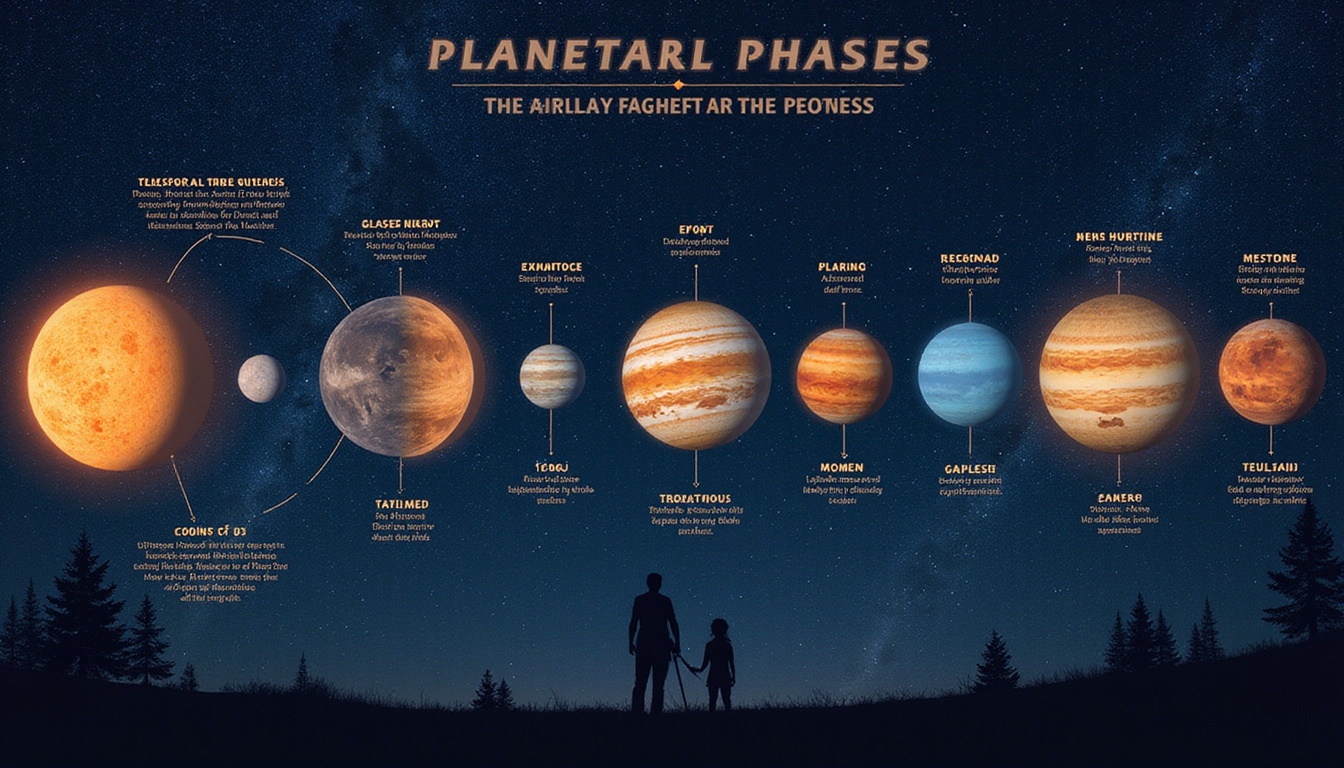
Mars: Phase Is Subtle, Brightness Is Not
Mars does show a slight phase, but it’s usually near “full”:
- Best time to observe: opposition, about every 26 months.
- At opposition, Mars appears brightest and largest, with an almost fully illuminated disk.
Closer to conjunction (when it’s near the Sun), Mars is farther from Earth and smaller, with a subtle gibbous phase visible in good telescopes. For most beginners, the big deal with Mars is size and surface detail, not dramatic phases.
Jupiter and Saturn: Nearly Always Full
Jupiter and Saturn:
- Are far beyond Earth’s orbit.
- Show only minimal phases from our vantage point (slightly gibbous when near conjunction).
For practical sky-watching:
- Treat them as nearly always “full.”
- Focus instead on timing them at or near opposition for peak brightness and best views of cloud bands (Jupiter) and rings (Saturn).
Even without noticeable planetary phases, their changing apparent size and brightness still follow the same geometry principles.
How to See Planetary Phases with Basic Gear
You don’t need expensive equipment to start appreciating planetary phases, but certain tools help a lot.
Naked Eye
- You can’t directly see crescent shapes of planets without magnification.
- But you can notice:
- Changes in brightness over weeks or months.
- Shifts in position relative to the Sun (closer to dusk/dawn or more separated).
Tracking these changes builds intuition about orbits and celestial motion.
Binoculars
- Low-power binoculars (7× or 10×) may hint at Venus’s crescent when it’s very large and bright.
- Helpful for locating planets near the horizon in twilight.
Binoculars are limited for detailed planetary phases, but they’re a great entry point.
Small Telescope (60–130 mm Aperture)
A simple beginner telescope transforms your understanding of planetary phases:
-
Venus:
- Clear crescent, half, and gibbous phases.
- Easily observable from a city.
-
Mercury:
- More challenging due to low altitude and twilight, but phases can be seen in steady air.
-
Mars, Jupiter, Saturn:
- Slight phases for Mars.
- Jupiter and Saturn look nearly full but reveal atmospheric bands and rings.
Use a magnification of 60×–150× for the best phase views, depending on seeing conditions and your telescope’s capabilities.
Best Times of Year to Watch Planetary Phases
The “best time” depends on which planet and your location, but some general patterns apply.
-
Venus:
- Seek it as an “evening star” (west after sunset) or “morning star” (east before sunrise).
- Greatest elongations are prime times for phase observations.
-
Mercury:
- Look for greatest elongation dates; they occur several times per year.
- Best visibility often happens when its elongation coincides with a steep angle of the ecliptic relative to your horizon (spring evenings or autumn mornings in many mid-latitude locations).
-
Mars, Jupiter, Saturn:
- Target opposition dates, when they’re up all night and at their brightest and largest.
- Opposition cycles differ for each planet (e.g., Mars every ~26 months).
NASA, major observatories, and reputable astronomy websites publish annual observing guides and opposition/elongation dates (for example, see the observing tools and sky calendars at NASA’s Skywatching resources (source)).
Practical Tips for Beginner Sky-Watchers
To get the most out of observing planetary phases, combine knowledge with good technique.
-
Use a stable mount
- Shaky views destroy detail. Even a basic tripod or sturdy alt-az mount is a big upgrade over hand-holding.
-
Let your equipment cool
- Telescopes need time to adjust to outdoor temperatures.
- 20–40 minutes can noticeably sharpen views.
-
Avoid low-altitude targets when possible
- Planets close to the horizon shimmer in atmospheric turbulence.
- Aim to observe when they’re higher in the sky, even if that means waiting later in the evening.
-
Shield your eyes from stray light
- Streetlights or porch lights can reduce contrast.
- Use a hood, your hand, or observe from a darker corner.
-
Keep an observing log
- Note date, time, planet, phase appearance, and conditions.
- Over weeks, you’ll literally see planetary phases evolving in your notes.
A Simple Checklist for Your First Planetary Phase Session
Before heading outside, run through this quick checklist:
- [ ] Check a sky map/app for current planet positions.
- [ ] Identify whether Mercury or Venus is visible (evening or morning).
- [ ] Note if any outer planet is near opposition.
- [ ] Prepare binoculars or telescope with a stable mount.
- [ ] Give your optics time to cool to outdoor temperature.
- [ ] Start with low magnification; increase gradually.
- [ ] Sketch or describe the planetary phase you see.
Using this list makes each session more intentional and productive.
FAQ: Common Questions About Planetary Phases
1. Do all planets have phases like the Moon?
All planets exhibit phases in the sense that only part of their sunlit side may be visible from Earth at any given time. However, only the inner planets, Mercury and Venus, show dramatic planetary phases from thin crescents to nearly full. Outer planets mostly appear full or slightly gibbous because, from Earth’s perspective, we’re always looking at their sunlit side.
2. Why are the phases of Venus so important in astronomy history?
The phases of Venus were crucial evidence for the heliocentric (Sun-centered) model of the solar system. Galileo’s telescopic observations of Venus showing a full range of phases could be naturally explained if Venus orbits the Sun, not Earth. This matched predictions of the Copernican model and conflicted with a strictly Earth-centered universe.
3. Can I photograph planetary phases with basic equipment?
Yes, especially for Venus planetary phases. With a modest telescope and a smartphone or basic planetary camera:
- You can capture the changing crescent shape of Venus over weeks.
- A sturdy mount and short video clips (then stacked with free software) greatly improve results.
Mercury’s small size and low altitude make it tougher, but Venus is very beginner-friendly for planetary phase photography.
Understanding planetary phases turns random bright “stars” into dynamic worlds with predictable patterns. When you look up and see a bright object near the horizon at dusk, you’ll know whether to expect a slender crescent Venus or a distant, nearly full Jupiter shining at opposition.
If you’re ready to do more than just glance at the night sky, make your next clear evening an experiment: check a planet chart, aim binoculars or a small telescope at Venus or Mars, and observe their current phase. Then come back a week later and compare. With each session, you’ll build skills, confidence, and a deeper connection to the moving architecture of our solar system.
Learn how astronomy, psychology, and spiritual traditions intersect by visiting SpiritualMindScience.com for deeper insights.