Planetary tides reveal surprising forces shaping oceans, climates, and life
Our world is shaped by invisible rhythms. Twice a day, most coastlines see the water rise and fall, yet those familiar waves are only the surface expression of a far deeper story. Recent research shows that planetary tides do far more than move ocean water in and out: they sculpt the seafloor, influence climate over millennia, affect Earth’s rotation, and may even set the stage for life on other worlds.
In this article, you’ll see how tides link the Moon, oceans, atmosphere, and biosphere into one powerful planetary engine—and why that matters for the future of Earth and for the search for habitable exoplanets.
What are planetary tides, really?
When most people think of tides, they imagine the ocean going high and low at the beach. Scientifically, though, planetary tides are the large-scale deformations of an entire planet—its oceans, atmosphere, and even its solid rock—caused by gravitational forces from other bodies, primarily the Moon and the Sun.
Three main components interact:
- Ocean tides – The rise and fall of sea level driven by the gravitational pull of the Moon and Sun and by Earth’s rotation.
- Atmospheric tides – Small but widespread pressure and wind patterns in the air, driven by both gravity and solar heating.
- Solid Earth tides – The actual flexing of Earth’s crust by up to ~40 cm as the planet is pulled slightly out of shape.
Together, these form a complex, global system of planetary tides that transfers energy and angular momentum through Earth’s interior, oceans, and atmosphere.
How planetary tides shape our oceans
Tidal forces as underwater sculptors
Tides are not just surface waves. In many regions, fast-moving tidal currents race through narrow straits, around headlands, and over rough topography. As they do, they:
- Erode and reshape continental shelves
- Stir sediments on the seafloor
- Carve channels and submarine sand dunes
- Maintain estuaries and deltas
Over millions of years, this constant “kneading” helps sculpt coastlines and underwater landscapes. Strong tidal energy zones—like the Bay of Fundy, the English Channel, or Indonesia’s straits—are hotspots of this geological work.
Tides and the deep ocean conveyor
Planetary tides are also crucial for ocean mixing, which affects everything from nutrient cycles to climate. When tidal currents flow over seafloor ridges and seamounts, they generate internal waves that travel through the ocean’s interior. As those waves break, they mix cold deep water with warmer surface water.
This mixing:
- Helps drive the global overturning circulation, the “conveyor belt” that moves heat and carbon around the planet.
- Distributes nutrients from deeper waters into the sunlit zone where plankton grow.
- Influences how much carbon the ocean can absorb from the atmosphere.
Climate models that don’t represent tidal mixing properly can underestimate or misplace key circulation features, which affects long-term climate projections (source: NASA Earth Observatory).
The role of planetary tides in regulating climate
Tidal friction and Earth’s slow-motion clock
As tides move through the oceans, they encounter friction with the seafloor and coastlines. This tidal friction gradually converts some of Earth’s rotational energy into heat, ever so slightly slowing the planet’s spin.
Consequences include:
- Longer days over time – Hundreds of millions of years ago, Earth’s day was only about 21–22 hours long. Tidal friction has stretched it to the ~24 hours we know today.
- Moon’s outward drift – Conservation of angular momentum means that as Earth loses rotational energy, the Moon gains orbital energy and slowly moves away, currently about 3.8 cm per year.
This may sound abstract, but day length and lunar distance affect climate and biological rhythms. For example, shorter days in the distant past would have changed the pattern of heating and cooling, winds, and possibly storm systems.
Tides, circulation, and heat distribution
Planetary tides also shape climate through their control of ocean circulation and heat transport. When tidal mixing is strong:
- More heat is moved from the surface into deeper layers.
- Warm and cold water masses exchange more efficiently.
- The climate system can store and release heat on different timescales.
Conversely, in periods or regions with reduced tidal energy—such as past geological eras with different continental configurations—the ocean may have been more stratified, with stronger layering and less vertical mixing. This can influence:
- The intensity of ice ages
- The stability of monsoon systems
- Regional climate patterns such as El Niño–Southern Oscillation
Milankovitch cycles and tidal modulation
Over tens to hundreds of thousands of years, Earth’s orbit and tilt vary slightly—known as Milankovitch cycles—changing how sunlight is distributed on the planet and helping pace ice ages. Planetary tides can modulate how the climate system responds to those cycles by altering ocean heat storage and circulation.
The interaction is complex, but the key point is that tides are not isolated; they’re intertwined with orbital mechanics, solar input, and internal climate feedbacks.
Planetary tides and the evolution of life
Tidal zones as cradles of innovation
Life’s history on Earth is written in part along the shorelines. Many scientists argue that tide-influenced environments—intertidal zones, estuaries, and tidal pools—were critical settings for early biological innovation.
Tidal cycles provide:
- Regular wetting and drying that can concentrate organic molecules.
- Fluctuations in temperature, salinity, and oxygen that favor adaptable organisms.
- Safe, shallow environments protected from the hazards of the open ocean.
Some origin-of-life hypotheses suggest that repetitive drying and rewetting in tidal pools could help assemble complex organic polymers such as RNA and proteins. The daily and monthly rhythms of planetary tides may have been a natural “clock” that structured biochemical processes long before complex life evolved.
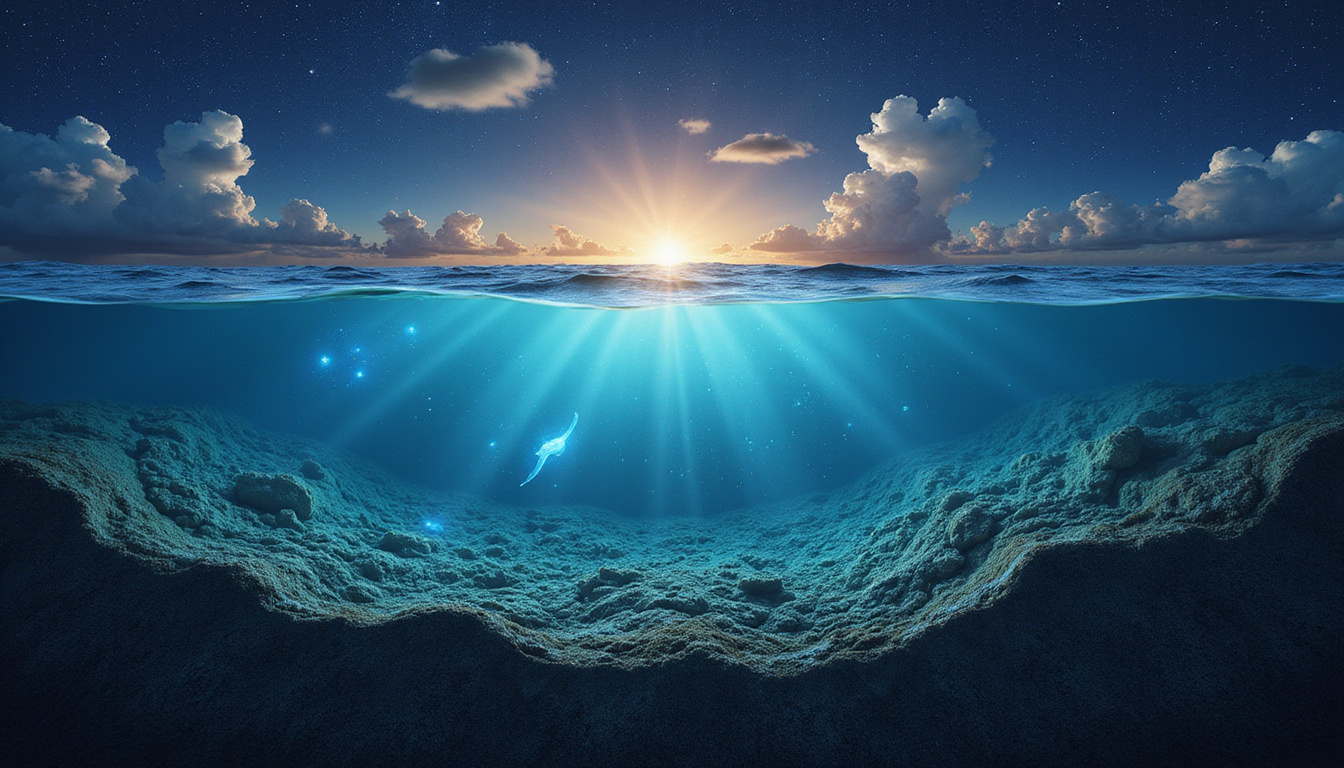
Biological clocks tuned to the tides
Even today, many organisms live by the clock of planetary tides:
- Intertidal animals like crabs, limpets, and barnacles synchronize feeding and shelter-seeking behaviors with the tide.
- Corals time mass spawning events not only with lunar phases but also with specific tidal cycles.
- Fish and marine mammals may follow tidal currents to migrate or hunt efficiently.
These behaviors rely on circatidal (about 12.4 hours) and circalunar (about 29.5 days) biological rhythms. In some species, internal clocks persist even in the absence of external cues, indicating deep evolutionary adaptation to tidal patterns.
As Earth’s tides change over geologic time—due to shifting coastlines and the receding Moon—life must continually adjust, linking planetary-scale physics to the story of evolution.
Beyond Earth: planetary tides and alien oceans
Tidal heating and ocean worlds
When we look beyond our planet, planetary tides become even more dramatic. In the outer Solar System, several moons experience intense tidal forces from their giant planet hosts, generating internal heat:
- Jupiter’s moon Io is the most volcanically active body in the Solar System due to extreme tidal flexing.
- Europa and Ganymede (Jupiter) and Enceladus (Saturn) likely harbor global subsurface oceans kept liquid by tidal heating.
- These oceans may be stable for billions of years, even far from the Sun’s warmth.
In these cases, planetary tides are not just shaping ocean circulation—they are literally the power source that keeps water from freezing solid. That makes them prime candidates in the search for extraterrestrial life.
Tidal locking and exoplanet climates
Many planets orbiting close to their stars, especially around cool red dwarfs, become tidally locked: one side always faces the star, the other lies in eternal night. Planetary tides are what slow the rotation and create this locked state.
The climatic consequences can be huge:
- Without enough atmosphere or ocean to move heat around, the day side may scorch while the night side freezes.
- With thick atmospheres or oceans, heat transport could moderate temperatures, potentially allowing habitable conditions in a band around the terminator (the line between day and night).
- Tidal heating could warm the interior, driving tectonics or volcanism that deliver nutrients to the surface or subsurface oceans.
Astrobiologists now consider the balance between stellar radiation, atmospheric composition, and tidal effects when assessing whether an exoplanet might be habitable.
Surprising connections: tides, earthquakes, and ice sheets
Can planetary tides trigger earthquakes?
The solid Earth flexes under tidal forces just like the oceans. While the effect is small, some studies have found correlations between tidal stress and the timing of certain types of earthquakes, particularly:
- Shallow quakes near mid-ocean ridges
- Tectonic tremor in subduction zones
- Earthquakes already very close to failure
Planetary tides do not cause earthquakes by themselves, but they may act as a final nudge on faults that are already critically stressed, slightly influencing when they occur.
Tides and melting ice
As the climate warms, planetary tides are playing an unexpected role at the edges of ice sheets:
- Strong tides under floating ice shelves can pump warm water into contact with the ice, enhancing melting from below.
- Tidal flexing can open and close fractures, influencing how quickly meltwater drains and how ice flows.
- In places like Greenland and Antarctica, the interaction of tides, ocean currents, and glaciers is now a key research frontier for sea-level rise projections.
This adds a new layer of complexity: the same tides that help regulate long-term climate can also amplify the effects of modern climate change in some regions.
Key ways planetary tides shape Earth and beyond
To summarize the reach of planetary tides:
- Reshape oceans and coasts through currents, erosion, and seafloor sculpting.
- Drive ocean mixing that powers the global conveyor belt and influences climate.
- Slow Earth’s rotation and push the Moon away via tidal friction.
- Modulate climate by altering heat storage and circulation over long timescales.
- Create ecological niches and rhythms that guide evolution and behavior.
- Heat distant moons and sustain subsurface oceans in the outer Solar System.
- Control rotation states (including tidal locking) that shape exoplanet climates.
- Influence geohazards like ice loss and, at the margins, earthquake timing.
In other words, planetary tides are not background noise; they are a major structural force in planetary systems.
FAQ about planetary tides and their effects
Q1: How do planetary tidal forces differ from regular ocean tides?
“Regular” ocean tides are one expression of planetary tidal forces, which act on the entire planet—oceans, atmosphere, and solid rock. Planetary tides encompass ocean tides, atmospheric tides, and solid Earth tides together as one interconnected system.
Q2: Can planetary tidal cycles affect long-term climate change?
Yes. Over long timescales, variations in planetary tides—due to shifting continents, changing ocean basins, and evolving Earth–Moon distance—alter ocean mixing and heat transport. This can reinforce or dampen natural climate cycles and influence how the climate system responds to other drivers.
Q3: Why are planetary tidal effects important for exoplanet habitability?
On exoplanets, planetary tidal forces can slow rotation, cause tidal locking, and generate internal heating. These processes control whether oceans stay liquid, how heat is distributed between day and night sides, and whether tectonic or volcanic activity supplies nutrients—key factors in assessing whether a world could support life.
Planetary tides: understanding the hidden forces that shape our future
From the gentle rise and fall of your local shoreline to the boiling volcanoes of Io and the hidden oceans of Europa, planetary tides are a quiet but relentless architect of worlds. They regulate our climate, guide evolution, and may determine which distant planets and moons can sustain life.
As we refine climate models, plan coastal infrastructure, and search the skies for habitable exoplanets, building a deeper understanding of planetary tides is no longer optional—it’s essential.
If you’re involved in ocean science, climate research, space exploration, or simply curious about how the cosmos shapes our everyday world, now is the time to delve deeper into tidal physics and their planetary-scale consequences. The more precisely we can map and model planetary tides, the better we’ll understand Earth’s changing climate and identify other worlds where oceans, climates, and life might thrive together.
Learn how astronomy, psychology, and spiritual traditions intersect by visiting SpiritualMindScience.com for deeper insights.