The synodic period is one of those deceptively simple astronomical ideas that quietly explains a lot of what we see in the sky: from how often planets appear to “meet” each other to why eclipses don’t happen every month. Understanding synodic periods opens a window into planetary alignments, retrograde motion, and the timing of solar and lunar eclipses.
What Is a Synodic Period?
In astronomy, the synodic period is the time it takes for a celestial body (like a planet or the Moon) to return to the same position relative to the Sun as seen from Earth. In practical terms, it’s the interval between similar configurations, such as:
- One full moon to the next full moon
- One opposition of Mars to its next opposition
- One conjunction of Venus with the Sun to the next
This is different from a sidereal period, which is the time it takes an object to complete one orbit relative to the distant stars. The synodic period is Earth-centered (what we see from here), while the sidereal period is space-centered (what the orbit is in absolute terms).
Because Earth is moving around the Sun as other objects orbit as well, the synodic period is usually different from the sidereal period—sometimes longer, sometimes shorter—depending on whether the object orbits closer to or farther from the Sun than Earth does.
Synodic vs. Sidereal Periods: Why the Difference Matters
To really see what the synodic period reveals about alignments, you need to contrast it with the sidereal period.
-
Sidereal period:
How long the body actually takes to complete one orbit around the Sun relative to the background stars. -
Synodic period:
How long it takes for the body to repeat the same configuration with the Sun as seen from Earth (e.g., from opposition to opposition).
Because both Earth and the other body are moving:
- If a planet is inside Earth’s orbit (Mercury, Venus), it moves faster around the Sun than Earth does.
- If a planet is outside Earth’s orbit (Mars, Jupiter, etc.), it moves slower than Earth.
This relative motion is what creates the difference between sidereal and synodic periods.
Mathematically, for planets, astronomers often use this relationship:
[
\frac{1}{S} = \left|\frac{1}{P} – \frac{1}{E}\right|
]
Where:
- (S) = synodic period
- (P) = planet’s sidereal period
- (E) = Earth’s sidereal period (1 year)
This simple formula already hints at how alignments repeat only when the relative positions “catch up” again.
How the Synodic Period Shapes Planetary Alignments
Planetary alignments—like oppositions, conjunctions, and groupings of planets in the same area of the sky—are governed by synodic periods.
Oppositions and Conjunctions
For outer planets (Mars and beyond):
- Opposition = Earth lies between the Sun and the planet (planet rises when the Sun sets).
- Conjunction = the planet is on the far side of the Sun from Earth.
The synodic period tells us how often an outer planet comes back to opposition or conjunction.
Examples (approximate):
- Mars: synodic period ≈ 780 days (~2.1 years)
- Jupiter: synodic period ≈ 399 days (~1.1 years)
That’s why Mars is not at its closest and brightest every year, and why Jupiter opposition happens a bit over once per year.
For inner planets (Mercury, Venus):
- Inferior conjunction = the planet is between Earth and the Sun.
- Superior conjunction = the planet is on the far side of the Sun.
Their synodic periods determine how often they go through a full “cycle” of phases and elongations from our point of view.
Synodic Period and Retrograde Motion
Retrograde motion—the apparent backward motion of planets against the background stars—is also tied to the synodic period.
For outer planets, retrograde motion occurs around the time of opposition, when Earth, on a faster inner track, overtakes the slower planet. The timing and recurrence of this phenomenon follow the planet’s synodic period:
- Each time the planet reaches a similar position relative to Earth and the Sun, a similar retrograde loop appears.
- The pattern of when retrograde begins and ends is therefore locked to the synodic cycle, not just the sidereal orbit.
This is why Mars, for example, shows a retrograde loop roughly every 26 months—the length of its synodic period.
The Moon’s Synodic Period and the Phases
The synodic period of the Moon is perhaps the most familiar example because we see it as the cycle of lunar phases:
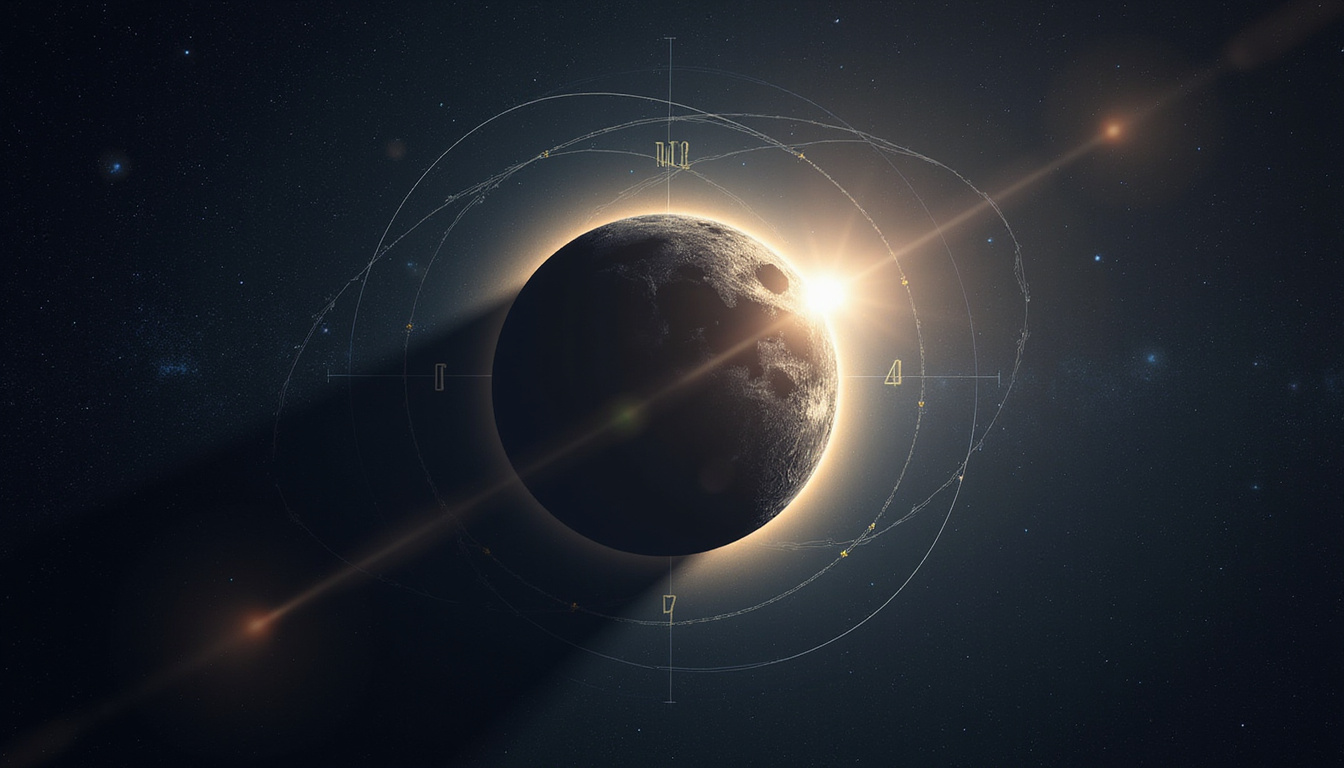
- Sidereal period of the Moon: ~27.3 days (orbit relative to stars)
- Synodic period (lunation): ~29.5 days (new moon to new moon)
Because Earth moves along its orbit during the Moon’s sidereal month, the Moon needs extra time to realign with the Sun-Earth line to become “new” again. That extra ~2.2 days is the difference between sidereal and synodic.
This ~29.5-day synodic period underpins:
- The length of the lunar month
- The timing of full moons
- The recurrence of many cultural lunar calendars
Why Eclipses Don’t Happen Every Month
If the Moon’s synodic period is about 29.5 days, you might expect a solar eclipse at every new moon and a lunar eclipse at every full moon. That doesn’t happen because of orbital tilt and the need to combine several different cycles.
Orbital Tilt and Nodes
The Moon’s orbit is tilted by about 5° to Earth’s orbit (the ecliptic). Eclipses can occur only when:
- The Moon is at or very near a node (the point where its orbit crosses the ecliptic), and
- It is a new moon (for solar eclipses) or full moon (for lunar eclipses).
So, eclipses require an alignment of:
- The lunar synodic period (phase cycle)
- The movement of the Moon’s nodes around Earth
- Earth’s position in its orbit around the Sun
Because these cycles are not perfectly commensurate, only a few opportunities for eclipses arise each year, clustered in what astronomers call eclipse seasons.
The Role of the Synodic Period in Eclipse Seasons
Eclipse seasons occur about every six months, when the Sun is close to one of the lunar nodes. During each eclipse season:
- If a new moon happens near the node, you can get a solar eclipse.
- If a full moon happens near that node (about two weeks earlier or later), you can get a lunar eclipse.
The ~29.5-day synodic period sets the timing of new and full moons within those brief windows. Without understanding the synodic period, predicting when the Moon’s phase will line up with the nodes would be impossible.
The Saros Cycle: Synodic Periods and Repeating Eclipses
Eclipses famously repeat in patterns. One of the most important is the Saros cycle, about 18 years, 11 days, and 8 hours long. After one Saros:
- The Sun, Earth, and Moon return to nearly the same relative geometry.
- A very similar eclipse (solar or lunar) occurs.
This cycle exists because three different periods line up approximately:
- Synodic month (phase cycle) ≈ 29.53 days
- Draconic month (node-to-node cycle) ≈ 27.21 days
- Anomalistic month (perigee-to-perigee cycle) ≈ 27.55 days
After 223 synodic months, these three cycles are nearly in sync again. The synodic period is crucial here: it ensures that each eclipse in a Saros series occurs at almost the same phase and therefore with similar geometry. NASA and other agencies use this and related cycles to catalog past and future eclipses (source: NASA Eclipse Web Site).
Synodic Periods and Planetary Transits
When inner planets pass directly between Earth and the Sun, we see transits—small black dots crossing the solar disk (like the famous transits of Mercury and Venus). These events require:
- Inferior conjunction (planet between Earth and Sun), governed by the planet’s synodic period
- Proper alignment of orbital planes (similar to the Moon’s orbital tilt and nodes)
Mercury has a synodic period of about 116 days, but transits of Mercury don’t happen every time it reaches inferior conjunction, only when that conjunction happens near Mercury’s nodes. Again, the synodic period sets the schedule of opportunities; the orbital tilt controls which opportunities turn into visible transits.
Real-World Uses of the Synodic Period
Beyond explaining what we see in the sky, the synodic period has practical implications:
-
Space mission planning
Launch windows to Mars or other planets are based on synodic periods. For instance, optimal Mars launches occur about every 26 months, tied to the Earth–Mars synodic cycle. -
Calendar systems
Many ancient and modern calendars use synodic cycles of the Moon (lunar or lunisolar calendars) to define months and religious festivals. -
Observing guides
Amateur astronomers rely on synodic periods to plan observations of planets at their brightest (near opposition or greatest elongation) and to track repeating patterns in the sky.
Quick Reference: Key Synodic Periods
Here are some notable synodic periods (all approximate):
- Moon (new to new): 29.5 days
- Mercury: 116 days
- Venus: 584 days (~1.6 years)
- Mars: 780 days (~2.1 years)
- Jupiter: 399 days (~1.1 years)
- Saturn: 378 days (~1.0 year)
You can see how these values set the rhythm for when each planet comes into a similar alignment with Earth and the Sun.
Summary: What the Synodic Period Reveals
In a single concept, the synodic period explains:
- Why we see repeated patterns of planetary alignments
- Why retrograde motion is cyclical
- How often phases of the Moon repeat
- Why eclipses are rare and clustered in seasons
- How sometimes eclipses repeat with similar geometry in cycles like the Saros
By focusing on how long it takes an object to return to the same Sun–Earth configuration, synodic periods tie together a wide variety of sky phenomena into one coherent framework.
FAQ About Synodic Periods and Alignments
Q1: What is the synodic period of the Moon and how does it affect eclipses?
The synodic period of the Moon is about 29.5 days, the time from one new moon to the next. Eclipses require a new or full moon near a lunar node; this 29.5-day cycle determines when the phase is suitable for an eclipse during each roughly six-month eclipse season.
Q2: How does the synodic period of a planet relate to planetary conjunctions?
The synodic period of a planet is the time between similar alignments with the Sun and Earth, such as conjunctions or oppositions. For example, each time Mars returns to the same configuration (like opposition), one Mars–Earth synodic period has passed.
Q3: Why is the synodic month longer than the sidereal month?
The synodic month (29.5 days) is longer than the sidereal month (27.3 days) because during the Moon’s orbit, Earth moves along its path around the Sun. The Moon must travel a bit farther than one sidereal orbit to line back up with the Sun–Earth line and complete a synodic period.
Understanding the synodic period transforms the sky from a collection of random events into a predictable, interconnected system of cycles. If you’d like to dig deeper into how these periods are calculated, how they’re used in eclipse prediction, or how they influence mission planning to other planets, ask for a step-by-step breakdown or specific examples—I can walk you through the numbers and help you apply them to real-world observing or spaceflight scenarios.
Learn how astronomy, psychology, and spiritual traditions intersect by visiting SpiritualMindScience.com for deeper insights.